
Most local service businesses struggle because they apply advanced tactics before they’re eligible for results.
The Maps Visibility System (MVS) was built to fix that problem by enforcing qualification before execution.
This is about operating within reality.
Why Google Maps rewards maturity
Google Maps responds to compounded trust signals. Visibility improves when Google sees consistency between an established business entity, real customer behavior, and pages that reinforce relevance and experience.
When those signals move together, results compound. When they don’t, performance stalls or becomes untrackable.
That’s why Maps Visibility System starts with eligibility.
The one qualification signal that actually matters
Early conversations about revenue are awkward and unreliable. Self-reported numbers are often inflated, deflated, or framed to impress.
Instead, Maps Visibility System uses a proxy that correlates strongly with operational maturity: having at least 200 legitimate five-star Google reviews.
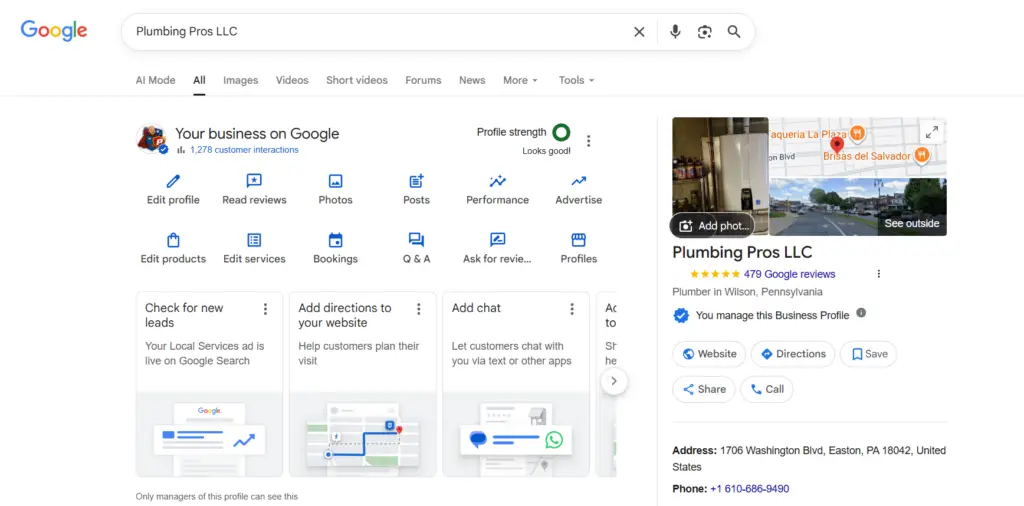
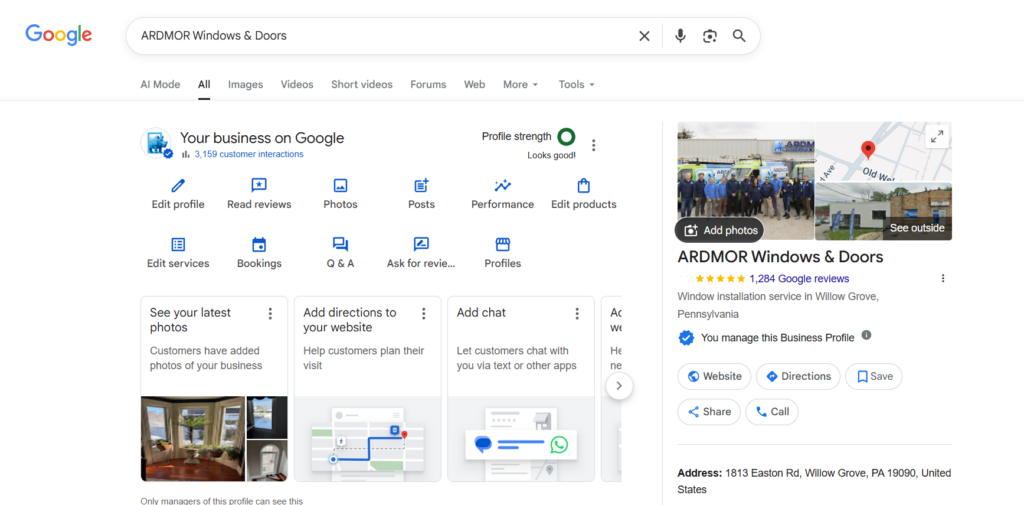
This threshold signals real customer volume, longevity, and operational stability. It also indicates that a business already understands service delivery and reputation management well enough for visibility amplification to work.
Without this baseline, even the best Maps strategy can’t be reliably accelerated.
How the qualification flow works in practice
Every prospect enters through the same public qualification form.
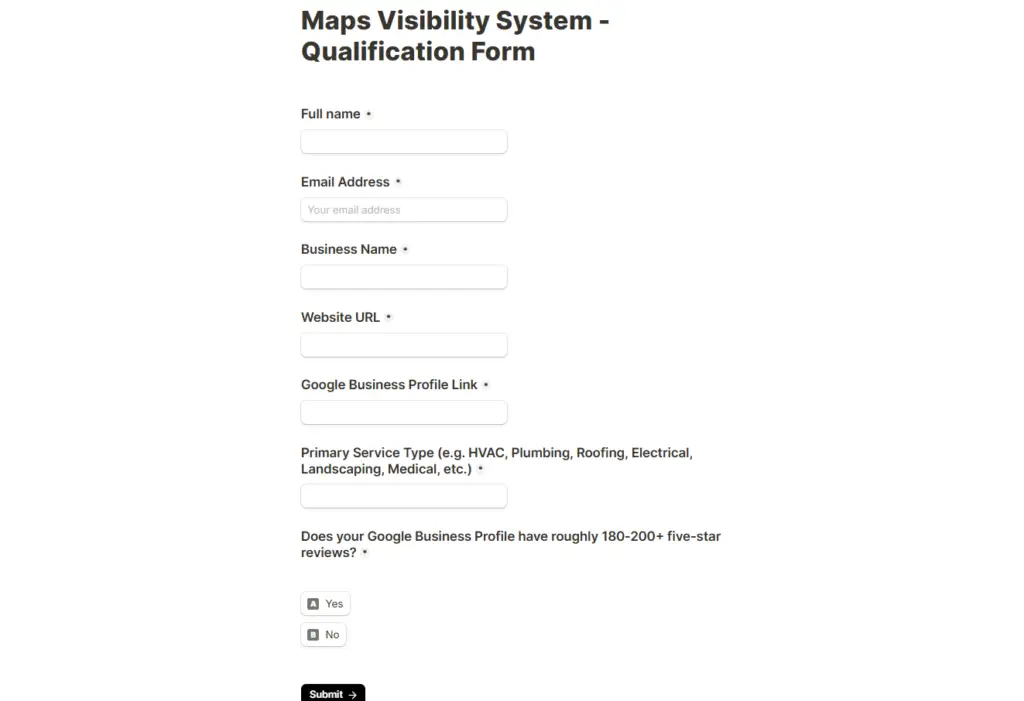
They provide basic contact information, their website URL, their Google Business Profile link, and their primary service category. The critical question is simple: does the Google Business Profile have at least 200 five-star reviews?
Internally, the logic is intentionally binary. If the answer is no, the flow ends. If the answer is yes, the prospect moves forward.
There are no partial passes, edge cases, or exceptions. This protects the team, preserves results, and keeps the system scalable.
What happens if a business doesn’t qualify
Disqualification is not rejection. Businesses that don’t meet the criteria are given a clear explanation and practical guidance.
They’re encouraged to focus on collecting legitimate reviews, strengthening their Google Business Profile, and building real experience and proof into their Location Service Pages. Once those fundamentals are in place, they’re welcome to reapply.
What qualified businesses receive instead of a pitch
Only qualified businesses see the option to book a Quick Audit. This call is not a sales call and doesn’t require access to accounts.
During the audit, current Maps visibility is reviewed, existing strengths and gaps are identified, and realistic service areas and keywords are discussed. The free initial phase of work is explained in plain terms so expectations are aligned before anything is done.
Why the first phase is free
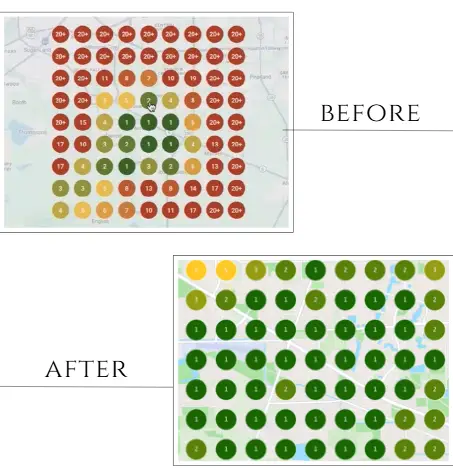
After the audit, the first phase of Maps visibility work is executed at no cost. This phase typically runs for one to two weeks and focuses on testing movement and validating assumptions.
Only after results are reviewed does the conversation turn to continuation. If the data supports it, the ongoing Maps Visibility System is offered at $1,500 per month. If it doesn’t, both sides walk away cleanly.
Why this model scales across verticals
The structure of the Maps Visibility System doesn’t change between HVAC, roofing, plumbing, or other local service categories. Only the language, examples, and figurehead positioning shift.
That consistency allows the system to scale without breaking operations, overpromising results, or diluting quality. It also ensures that retention is driven by performance rather than persuasion.
The real advantage is signal alignment
Some agencies will eventually ask why businesses shouldn’t just buy Maps traffic directly.
The answer is simple. Traffic without proper entity structure, supporting pages, and measurement creates noise, not lift. Google responds to aligned signals, not isolated inputs.
Maps Visibility System works because entity structure, behavioral signals, and measurement move together. That combined signal is what Google rewards and what business owners can actually track.
The point of qualification is credibility
The fastest way to lose trust in local SEO is to promise results to businesses that aren’t ready.
The fastest way to build it is to qualify rigorously, execute cleanly, and let results speak.
That’s what the Maps Visibility System is designed to do.