Scaling a Door Business: A Shop Tour with Billy Cline

Billy Cline, owner of Your New Door, is scaling his door business by deliberately shifting his role from primary operator to leader, teacher, and system-builder.

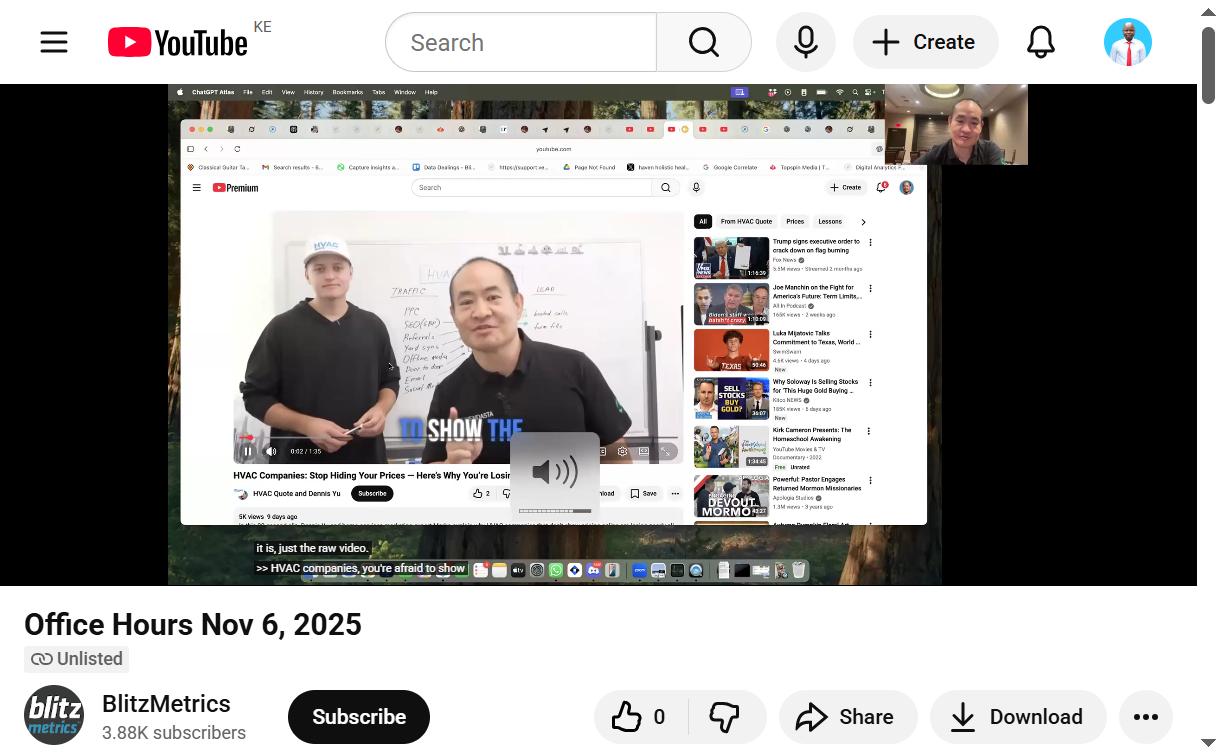
Dennis Yu visited Billy Cline at Your New Door in Dallas to record this shop tour as part of ongoing conversations with service business owners who are scaling past the operator stage and into leadership-driven growth.

The conversation focuses on how leadership, training, and internal capability compound over time inside a home service business.

The operating context shown in the tour

The conversation takes place inside Your New Door’s production facility, which Billy explains totals roughly 15,000 square feet, with an additional 12,000-square-foot space across the street being built out for a showroom and paint department. He notes that the company has been operating for about 15 years, and that much of the early period involved learning through mistakes rather than following a clear playbook.

This matters because the insights shared are not theoretical. They are framed as corrections made after years of operating without systems.

The inflection point: letting go of credit

One of the clearest moments in the video is Billy’s explanation of what actually limits growth for most contractors.

“There’s no limit to how far you can grow if you don’t care who gets the credit,” he says.

This statement anchors the rest of the tour. Billy repeatedly returns to the idea that scaling does not fail because of market demand or technical skill, but because owners refuse to stop being the center of execution.

This aligns with BlitzMetrics’ long-standing position that moving from technician to CEO is a role change, not a workload increase.

Leadership development as a scaling mechanism

Billy describes running a leadership book club inside the company. Two titles he explicitly references are How to Win Friends and Influence People and The 21 Irrefutable Laws of Leadership. He contrasts younger employees who are reading multiple books per year with older craftsmen who have not engaged in formal learning since high school.

His reasoning is not retention-focused. He states openly that employees will eventually leave.

The goal, as described in the video, is that when those employees later stand next to peers in similar roles, the ones trained in leadership and communication will outperform those who have only technical experience.

Paying for knowledge instead of labor

Another concrete principle Billy articulates is how compensation signals what a company values.

“I want to pay them for what they know, not what they do,” he explains.

This comes up in the context of an aging skilled workforce. Billy notes that many experienced craftsmen are efficient and task-oriented, but lack patience for training younger workers. His response is not to replace them, but to redefine their role from doer to teacher.

From a scaling perspective, this converts experience into multiplicative capacity instead of hourly output.

Market structure and the race to the bottom

Billy also explains why the replacement door market behaves the way it does. According to him, the market is fragmented. Large national brands dominate the high end, while low-end operators compete transactionally with minimal customer acquisition costs.

He explicitly rejects that low-end model, describing it as a race to the bottom that limits the ability to invest in people, systems, and leadership.

Why marketing changes as the business grows

Marketing enters the discussion when Billy describes different growth stages. Early on, the objective is simply to generate leads. Later, the cost of misalignment increases.

He references spending approximately $30,000 per month on PPC and working with agencies. At that level, he explains, disconnected messaging and delayed feedback loops become expensive.

“Everything needs to be tied together,” Billy says. “It’s really hard to have a congruent framework when you have agencies doing the work.”

This is the rationale he gives for owning his marketing by moving in-house, allowing for faster iteration, tighter alignment with operations, and clearer accountability.

What the video demonstrates for service business owners

The shop tour captures Billy at a clear transition point, explaining decisions as they are being made rather than reflecting on them after the fact. Billy is not presenting a final destination. He is explaining why certain structural decisions became necessary.

For home service business owners, the demonstrated takeaways are concrete:

  • Growth stalls when the owner remains the primary executor
  • Leadership training compounds even when employees eventually leave
  • Veteran technicians become leverage only when they teach
  • Fragmented markets punish price-only competition
  • Marketing spend without operational alignment accelerates waste

Why this video matters

This recording is valuable because it captures the middle of the journey, not a retrospective success story. The emphasis is on decisions being made while the business is still growing, not after outcomes are guaranteed.

As an analytical artifact, the video provides a clear example of how service businesses begin scaling by changing who makes decisions, how experience is leveraged, and where control must eventually live inside the organization.

If you’re working through a similar transition — moving from operator to system-builder — the next step is aligning marketing, leadership, and operations into one cohesive framework. Local Service Spotlight focuses specifically on helping home service businesses tie paid media, SEO, and internal execution together so growth compounds instead of creating operational strain.

Scroll to Top