
Jack Hughes showed up to our Office Hours session with a problem most podcasters know too well. He runs a show in the online tech safety space, and he could not get guests to reply to his emails.
“I’ve tried sending out a few emails and stuff like that,” Jack said. “So far, I haven’t gotten a lot of replies. I’m trying to figure out how I can best invite people on.”
That kicked off a conversation between me, Jack Wendt, Luke, Billy Hale, and a few others that ended up covering guest outreach, backlink strategy, and content repurposing. What started as one person’s podcast problem turned into a full breakdown of how domain authority actually gets built.
Stop Cold Emailing, Start Borrowing Trust
Jack Wendt jumped in right away. He asked Jack Hughes what kind of network he already had, and whether there was anyone he could plug into organically instead of cold pitching strangers.
Jack Hughes mentioned he had already gotten a guest named Nikki from Scrolling to Death on his show. She is well known in the online safety world. Jack Wendt told him to use that one relationship as a starting point.
His method was specific: “I would search up her LinkedIn connections. You can download her connections with their emails. Create a list of her connections and then just reach out to people in her network.”
He laid out the pitch: “Say, hey, we had an episode with Nikki, went really well. I know you guys are connected. Would you be willing to sit down and talk if we had some common alignment?”
Jack Wendt also suggested turning the podcast episode with Nikki into a written article and attaching it in the outreach email. “That’s just practicing what we preach,” he said, “repurposing the content that you’ve made and allowing your greatest hits to be exponentially used.”
Most people try to go wide with outreach when they should be going deep. One strong relationship can open ten doors if you ask for the next introduction.

Guest Appearances Are a Backlink Machine
We spent a good chunk of the call talking about what happens after you land a guest spot. When you appear on someone else’s podcast, a few things stack up in your favor:
- The host links to your website in the show notes, giving you a backlink from their domain.
- The episode gets listed on podcast directories like Apple, Spotify, and Podchaser, each with a link back to you.
- You get access to the host’s audience, which drives direct traffic and social signals that search engines pay attention to.
And it works both ways. When you feature someone on your own show, they share the episode with their audience. Jack Wendt put it plainly: “Every single one of your posts should have somewhere where the viewers can go. You want to create a funnel wherever you can because then you’re amplifying that effort.”
This is where the E-E-A-T framework becomes relevant. Google looks for experience, expertise, authority, and trust. Having real conversations with recognized people in your niche, published across multiple platforms, checks every one of those boxes.
Jack Hughes books Nikki. Nikki introduces him to three people in her network, and each of those guests shares the episode. That is four new backlinks from one relationship.
Turn One Episode Into a Week of Content
Jack Hughes brought up another challenge later in the session. He had been using Descript to cut clips from his podcast episodes and posting them on YouTube, Facebook, Instagram, TikTok, and X. But he was stuck on what else to do with the material.
“I’ve been taking clips from Descript that cut up my podcast, and I’ve been posting that on all the socials,” he said. “I kind of get frozen like, do I post a quick 30-character post on Twitter, do I do a photo on Instagram, and how often should I be doing that?”
I told him the clips are only the first layer. The real value is in the transcript. Take the full transcript from a podcast episode, and you can pull out blog articles, email newsletters, and social posts without creating anything from scratch.
A simple system looks like this:
- Record one long-form episode per week. That is your pillar content.
- Pull the transcript and use it to write a blog article on your website.
- Cut 2-3 short clips for TikTok, Reels, and Shorts.
- Send the article to your email list. Every published article should go out as a newsletter.
Luke backed this up from his own experience running a personal training business. “I try to take the concepts that we talk about in here and just apply it to basically the marketing side,” he said. “I like the idea of not having to do cold outreach. I really don’t like cold outreach. Just as a person, when I get people reaching out to me trying to sell their services, it really bothers me. So I try to have empathy for that when I’m trying to sell my services.”
His approach is relationship-first: build content from real conversations, then let the content do the selling. That is the Content Factory approach in practice. You create one piece of pillar content, break it into multiple formats, and each piece drives people back to your site. This is how we teach it in the AI Apprentice program as well.
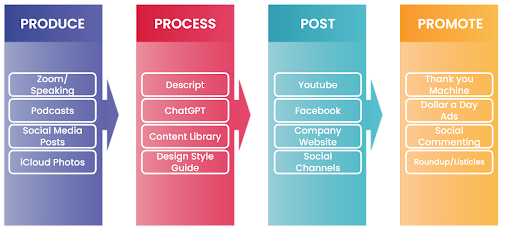
Every article you publish from a podcast episode creates a new indexed page on your site. Over time, those pages accumulate backlinks and organic traffic.
Your Newsletter Is a Distribution Engine, Not a Side Project
Billy Hale brought up his own situation during the session. He has a real estate newsletter he has been running for several years with about 1,500 subscribers and a 60-65% open rate. He was trying to push readers from the newsletter to his website through landing pages, but the connection between the two was not working yet.
“I’ve been kind of working on some web page landing page stuff,” Billy said, “just trying to get some of that stuff where it can go travel, you know, all the efforts kind of travel somewhere. Just some backend stuff, I guess, more than just doing the videos.”
He explained that his newsletter includes real estate sales data, and his readers are mostly interested in the data itself. But the data was sitting on Constant Contact instead of driving traffic to his own site. “I’m going to just have kind of an intro and then put the data sitting on a hyperlink, hyperlink it to a landing page,” he said.
That is exactly the right instinct. Every piece of content you publish on your website, whether it started as a podcast episode, a newsletter, or a data report, should push people toward your domain. The newsletter is the distribution engine. The website is where the authority lives.
The same principles apply whether you are a podcaster, a personal trainer, or running an HVAC content strategy. Create something valuable, send it to people who have already raised their hands, and include a clear next step.
What Actually Moves the Needle
Henry, who was also on the call, asked about setting up his own agency focused on dentistry clients. He had not built out any of the base accounts yet. “I haven’t set up my like anything with my agency yet, which I should probably get on at least creating the base accounts,” he said. “Like what do you recommend for that? Like the initial setup.”
Jack Wendt walked him through the basics, and the advice boiled down to one thing: pick a niche and go deep. Henry chose dentistry. Others in our group focus on HVAC, personal training, and other verticals. When every article, every guest appearance, and every backlink you earn points to the same topic, search engines see consistency and reward it. George Paladichuk followed a similar path with his personal brand, picking a lane and building content around it consistently.
After an hour of conversation, the thread that ran through every topic was the same. Domain authority does not come from tricks or shortcuts. It comes from real relationships that produce real content across real platforms.
One podcast guest leads to a backlink, an article, a newsletter send, short-form clips, and a warm introduction to the next guest. That single relationship can generate more authority than a hundred cold outreach emails.
Start with one guest. Work the relationship. Let the content do the rest.