
If you’re a young adult who wants to learn marketing, start with a real business and one clear problem. Bryce Clark learned by working on client projects, making videos, and taking feedback. His old project notes show how a short video can lead into an audit and a service you can actually deliver.
How one minute becomes useful work
- Show one finding
- Start an audit conversation
- Check the evidence
- Agree on one job
- Deliver and report
- Teach what you learned
Bryce’s basketball interest became real marketing experience
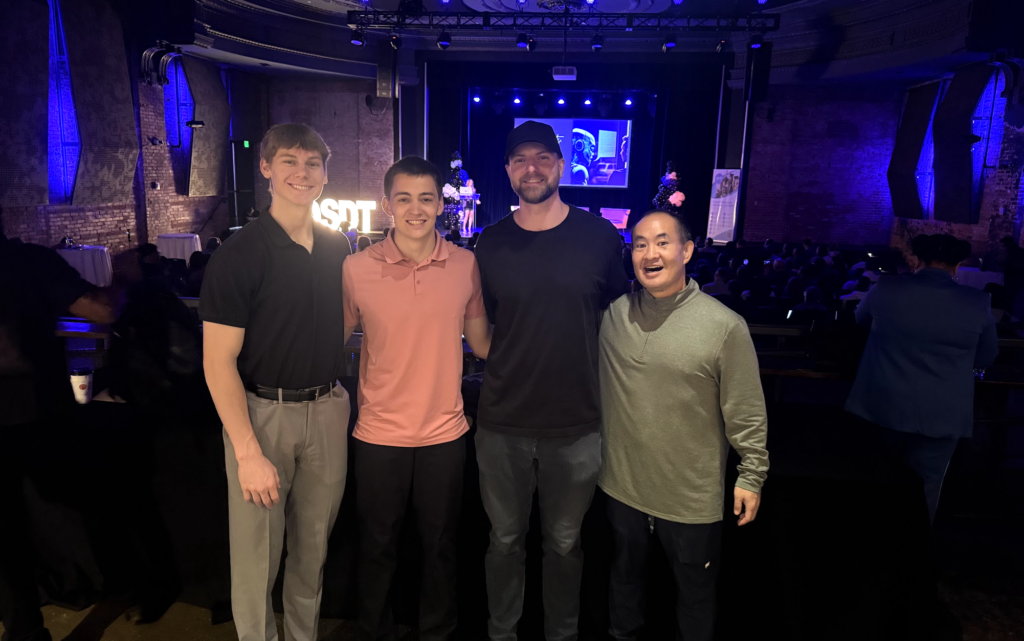
In our Detroit conversation, uploaded June 11, 2026, Bryce and I recalled speaking at a conference and teaching at a university in Hawaii. We also talked about working inside the Golden State Warriors’ offices and training facility on their campaigns. Bryce confirmed that he was about 20 at the time.
Basketball gave him a reason to care about the work. Marketing gave him something useful to contribute. The experience included client responsibilities, listening, campaign work, and explaining what he had learned.
There is an earlier version of this lesson in my SFIMA talk, uploaded May 26, 2015. I introduced college basketball player Aarun Rumbaugh and explained how a student’s interests could connect with commercial work. Later in that talk, I described certified students implementing quick-start packages.
Bryce’s own account supplies the Bryce-specific evidence. Those experiences show what happened in his case; they do not promise a Warriors assignment, travel, or a speaking slot to a new applicant.
The project notes show the work behind the opportunity
In December 2016, Bryce and Claudia Sheridan recorded a five-part Dollar-a-Day series: why the method matters, what it is, plumbing, content, and amplification. Our project discussion covered lighting, sound, diagrams, captions, branding, and where the videos would go.
On December 18, I encouraged Bryce to keep a room or a corner ready for regular one-minute recordings. The audience needed to see the thing he was explaining. A useful diagram or screen view could help. He could make the next version better instead of waiting for a perfect studio setup.
In January 2017, Bryce developed a Facebook optimization package with Amir Ishaq. Bryce described the next content task: make a quick video explaining what the package was and who it served. The offer also needed a delivery process. His written sequence was:
- Collect the client’s goals, content, and targeting.
- Get approved access to the Facebook ad account.
- Meet to discuss the goals and data.
- Tune the campaigns once.
- Discuss what changed.
- Deliver a final report.
We also clarified the boundaries of that historical package: a three-week strategy, campaign-building, and tuning exercise, focused on strategy, ads, and analytics. Content production and community management were outside that scope. The client had to qualify for the service.
By February 22, Bryce was working on a separate Facebook Ads audit offer. His checklist named another testimonial, a simple URL on his own site, a payment page, and a strategy assessment booked through Calendly.
That is practical business learning: make the offer clear, define who it helps, arrange the next step, and know how you will fulfill it. These records document his preparation and revisions. They do not establish how many people bought the offer or what revenue it produced.
What a young adult can say in one minute
Start with a business you understand and a finding you can show. Here is an example to adapt after checking a real website:
“I’m learning to help local businesses improve their marketing. On this page, I found a contact button that doesn’t work on my phone. I’ll show you what happened and the first thing I would check. An audit helps us agree on the problem before choosing what to fix. If you’d like me to review your site, send me the link.”
Only use the broken-button example if you have reproduced it. Show the page and explain the consequence. For ad-account findings, use the owner’s approved access and keep private customer and account data out of the public video.
The short video opens a conversation. The audit checks the evidence. A separate agreement defines any implementation work. A learner earns trust by delivering the job and explaining the result.
How this connects to the AI Builder Program
Bryce’s historical experience shows the learning method behind today’s AI Builder Program: learn on a real project, accept feedback, and show the work.
Today, the builder also manages AI agents for bounded tasks such as content processing, evidence collection, and reporting. The builder remains responsible for checking the output and respecting the business owner’s approvals. A fluent AI report still needs correct facts.
The current program is a selective, one-year apprenticeship for US-based young adults, priced at $7,500 one time. A qualifying participant or their parent can pay. Builders need at least five focused hours each week and a real project; a parent’s business can be that starting point.
The qualification process starts with a published one-minute video. It also checks whether the applicant can turn a longer video into an article, respond to feedback, and follow through on revisions. Payment follows acceptance.
For parents, the useful question is: can your young adult take responsibility for a small real task, explain what happened, and improve when coached? A clear video, a careful audit, and a finished report give you something concrete to evaluate.
Turn the work into a Content Factory
The Content Factory uses four stages: Produce → Process → Post → Promote. Record the useful moment. Turn it into a clear article and captioned clips. Post with a link to the maintained story and the relevant next step. Promote a proven piece only within an approved budget.
After implementation, report the metrics, explain what they mean, and choose the next action. The same work creates both client value and material that teaches the next builder. That is how a one-minute video becomes part of a learning and delivery system.
Why Active Listening Is the Skill Nobody Talks About
Ask Bryce what separates the people who succeed from those who don’t, and he doesn’t lead with tactics.
He leads with listening.
“By having conversations and actively listening to whoever you’re talking to — I think that can pay dividends no matter what aspect of life you’re looking for,” he says. “Whether that’s growing your career or meeting your wife or growing a family.”
This is something local service business owners understand intuitively — or should. The contractor who listens to a homeowner, the plumber who asks the right follow-up questions, the HVAC technician who remembers what a client told them last visit — these are the businesses that get referrals without asking.
Digital marketing amplifies what’s already working. It doesn’t replace the human foundation.
The GCT Foundation That Transfers Across Industries
One of the frameworks Bryce credits most is the Goals, Content, Targeting (GCT) approach that Dennis teaches — a way of thinking about every piece of content or campaign through the lens of who it’s for, what it needs to accomplish, and what message actually serves that person.
“Those skills are transferable,” Bryce says. “If I left the real estate industry and went to a completely different industry, I feel like I have a huge basis and foundation for pretty much anything… it would help me be successful way faster off the bat.”
That’s the real ROI of learning digital marketing properly. Not just the campaigns — the thinking. The ability to walk into any business problem and ask: what’s the goal, what’s the content, who are we targeting?
For local service businesses, that question alone can reshape how you approach everything from Google Business Profiles to door hangers to follow-up emails.
AI Is an Accelerant
Bryce is clear on where AI fits in his work.
“There’s no replacement for hard work,” he says. “It’s just an accelerant to whatever work you’re willing to put in.”
That’s an important distinction, especially right now when the promise of AI tools can make the work feel optional. Bryce has seen enough people chase shortcuts — chasing the money, skipping the skill-building, not showing up for clients — to know what actually sticks.
The people who win are the ones who use AI to do more of the work they’re already doing well — not to avoid doing the work in the first place.
For local service companies, this means using AI to write better follow-up emails, respond to reviews faster, create more content — while still showing up, still listening, still building relationships.
What Time Freedom Actually Looks Like
Bryce is married with two daughters. He manages rental properties. He’s in a golf league on Monday nights.
And when he’s standing on the first tee, he says he sometimes just wants to go home and be with his family.
“That’s like the point, the season that I’m at in my life right now,” he says. “I could dream of being in a golf league years ago — and now I’m like, I just wanna drop it.”
Time freedom isn’t the absence of things to do. It’s having built enough that the things you love most start competing with each other.
That’s the goal Dennis talks about for every entrepreneur — not just revenue, but a life where work and family and health aren’t fighting each other.
Sources and update: Historical process details come from December 2016–February 2017 preserved project discussions involving Bryce Clark and Dennis Yu. Public context comes from Bryce’s June 2026 interview and the SFIMA talk uploaded May 26, 2015. Current offer and qualification details were checked on October 5, 2026. This story connects the historical learning method to today’s program; it does not present Bryce as a participant in the current paid AI Builder Program.
Learning-path update: . Original interview and publication history retained.
Originally published .