
On Thursday, June 18, 2020, the Better Business Bureau handed its accredited members over to Dennis Yu for an hour. He kept them for an hour and twenty-eight minutes, and almost nobody left.
This is the full recording, the ten-step checklist the BBB put its own logo on, and every move Dennis made live on that call — rebuilt as a working playbook rather than a webinar recap.
It was recorded during COVID. Almost none of it is about COVID. Dennis said so himself, on the call, at the 1:15:00 mark:
We know that these are tried-and-true tactics. This has worked for 20 years. We’ve taught this together with Google and Facebook and GoDaddy. You can Google my name and you can see that I’m not making this up — there’s thousands of results where we’ve taught the same thing over and over. There’s nothing new here that we’re teaching. I don’t want to teach anything new. I only want to teach things that we’ve done many, many times over.
Dennis Yu, BBB workshop, June 18, 2020
That is the reason this page exists. Six years later, the platforms have new buttons and AI writes the first draft, but the ten things on the BBB’s slide are the same ten things we teach a plumber in Omaha today.
Watch the full workshop
What the BBB said before Dennis said a word
Every workshop has an introduction. Most of them are forgettable. This one is worth quoting, because it is the Better Business Bureau — an organization whose entire product is vouching for who is trustworthy — going on record.
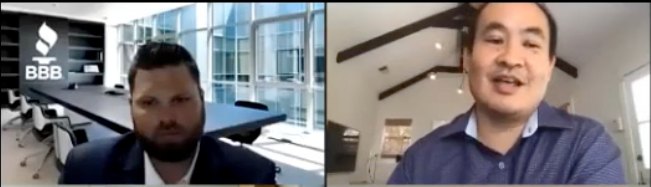
Niebaum opened the session like this:
We’re going to have some fun today learning from one of the top digital marketing Jedi Masters, if you will, of our time.
Jeff Niebaum, Better Business Bureau
Then he read the credentials into the record:
Dennis is an internationally recognized lecturer on Facebook marketing, and that’s why we chose him. He’s spoken to over 730 groups in 17 countries spanning five continents. He’s been featured in The Wall Street Journal, CBS Evening News, and co-authored Facebook Nation, a textbook taught in over 700 colleges and universities. His big clients include Nike and the Golden State Warriors NBA basketball team. But his real passion lies with small business.
Jeff Niebaum, introducing Dennis Yu
Dennis answered it thirty seconds later in his own way, which is the part worth keeping:
I’m a search engine engineer. I’m not just some random Asian guy that Jeff and Margo invited to do a webinar. I’m horrible on video, but I still keep practicing. If I can do it, you can do it.
Dennis Yu
The room
This was not a webinar where twelve people lurk with their cameras off. Two minutes in, the Zoom gallery was a full grid of business owners, several of them sitting in front of BBB-branded backgrounds.
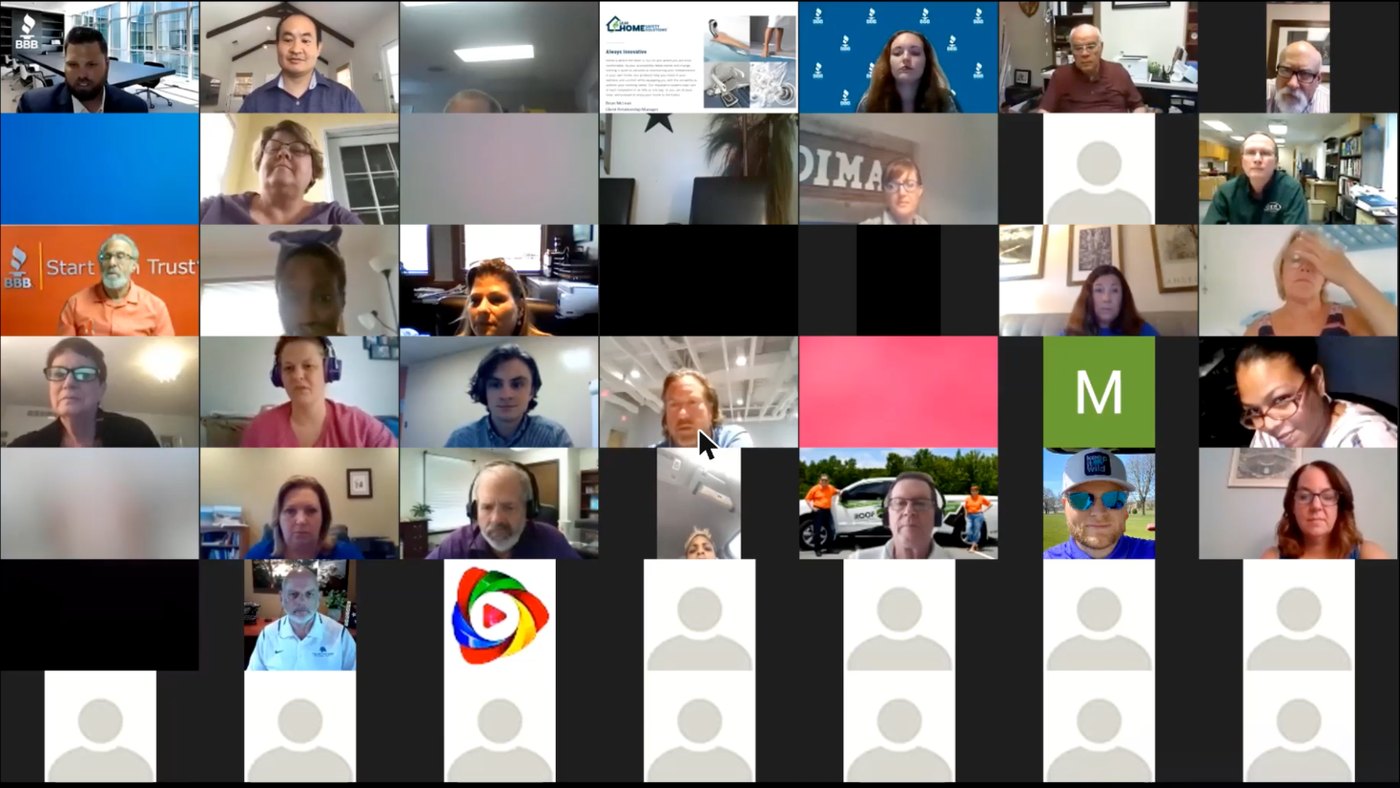
The session was scheduled for an hour. At the top of the hour Dennis asked whether people could stay another ten or fifteen minutes. They stayed. Here is the same gallery 78 minutes in — eighteen minutes past the advertised end:
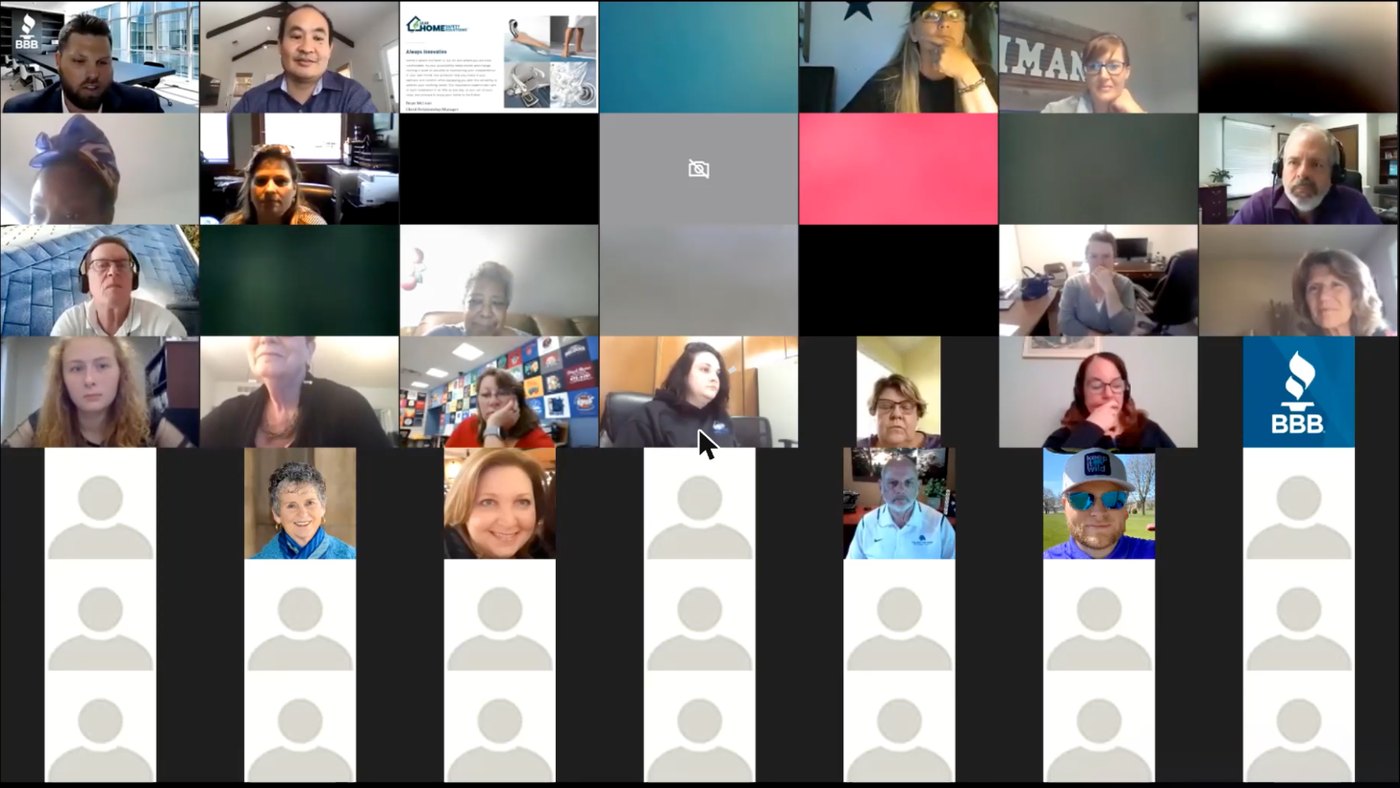
Niebaum’s closing remark, at 1:25:44, is the metric that matters:
We went well over time, but I was just looking at the participant [count] and it literally did not drop until just like ten seconds ago. So that’s testament to all the knowledge that you have provided to us. I tweeted out, my mind has been blown. I saw this gentleman up in Sioux Falls in February, before everything happened, and like you probably have now, I had like three pages of notes. So make sure you go back and re-watch this, look at his playbook, don’t try to tackle it all at one time.
Jeff Niebaum, Better Business Bureau
He also volunteered the detail that he had seen Dennis speak once before, in Sioux Falls, and booked him again. Repeat bookings are the only speaking testimonial that can’t be faked.
The checklist the BBB co-branded
Dennis and the BBB team built a twelve-page deck for the session. Page one is the whole strategy on a single slide. If you read nothing else on this page, read this slide.
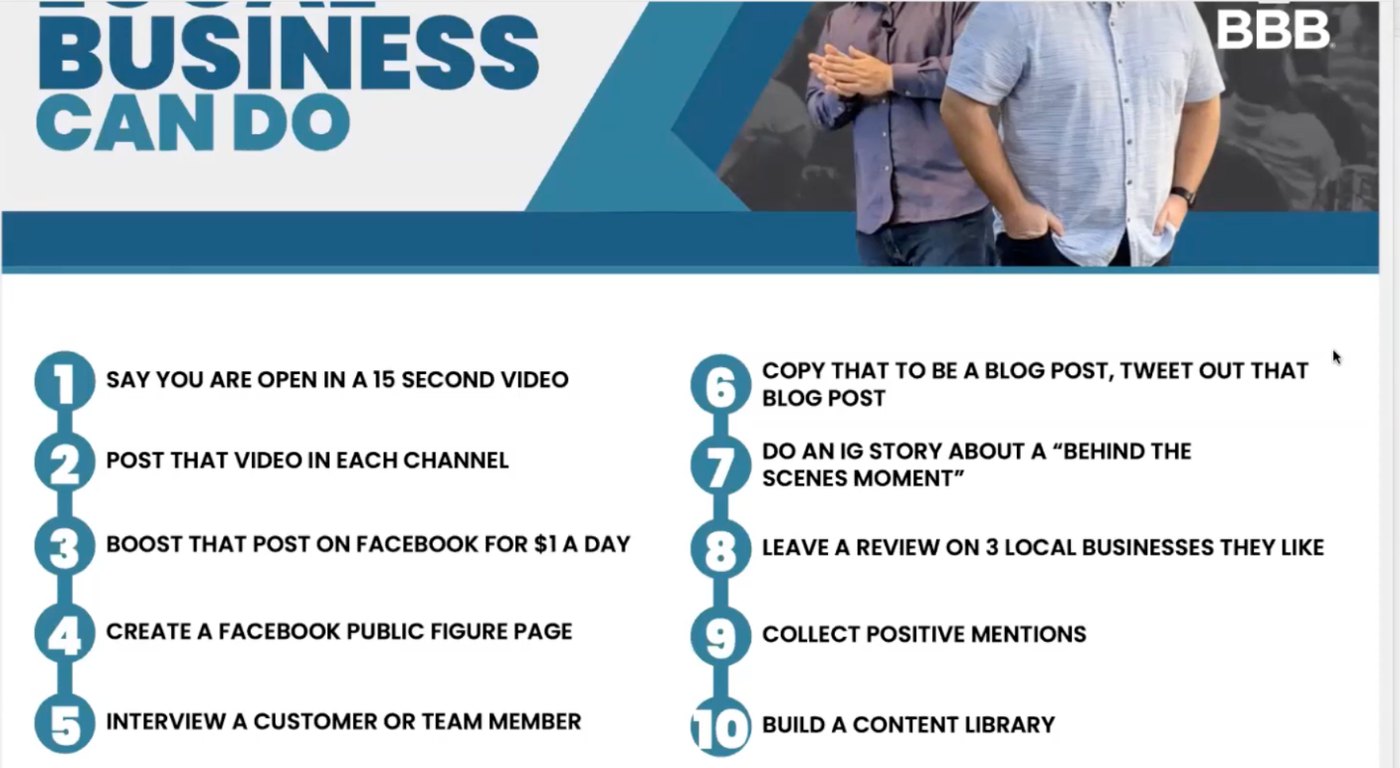
- Say you are open in a 15-second video
- Post that video in each channel
- Boost that post on Facebook for $1 a day
- Create a Facebook public figure page
- Interview a customer or team member
- Copy that to be a blog post, tweet out that blog post
- Do an IG story about a “behind the scenes moment”
- Leave a review on 3 local businesses they like
- Collect positive mentions
- Build a content library
Notice what is not on that list. No agency. No software purchase. No content calendar. No campaign. Dennis named this directly at 5:13:
The biggest issue we’ve seen with small businesses is they’re not doing these simple things. You don’t have to hire agencies, you don’t have to spend a lot of money, you don’t have to buy all the software.
Dennis Yu
The ten, one at a time
1. Say you are open, in a 15-second video
Dennis did not describe this one. He pulled out his phone on the call and shot it:
Hi, my name is Dennis Yu and we are open today, Thursday, June 18th, for your business. You can always reach us online, you can reach me by phone, and wherever you are you can come visit us.
Then he gave the room 60 seconds to do the same thing and post the link in the chat. That is the entire method: name, business, one true sentence, today’s date. No script, no editing, no ring light.
He paired it with the unglamorous fix underneath it — log into your Google Business Profile and correct your hours, because a listing that says “hours may differ” is quietly costing you calls.
When someone asked how often to do it, the answer was the whole discipline in one line: “Every day you need to be saying this. Some people will say, ‘Yeah, but I already said it two months ago.’ Yeah, but did you say it today?”
Go deeper: the 15-Second Video course and the power of one-minute videos, which breaks down the timing — hook in the first three seconds, pain or pleasure by fifteen, the solution by fifty, the ask in the last ten.
2. Post that video in every channel
One recording, five destinations. On the call Dennis took the clip he had just shot and pushed it to a Facebook story, a Facebook post, his personal LinkedIn, the company LinkedIn, and Twitter — without editing anything in between.
Later he showed the shortcut most people miss: post to Instagram with Facebook and Twitter connected, and one upload lands in three places at once. Then boost each one separately.
3. Boost that post for a dollar a day
Dennis spent real money on the call, in front of everyone, twice. Seven dollars each time. The recipe he used:
- Objective: more engagement, not clicks — “90% of the time you’re going to click get more engagement, because you want to drive social proof, and the cost of traffic is less”
- Audience: your service radius. “If you’re in one location and you draw a five-mile circle around it, that usually is going to be only seven to ten thousand people”
- Budget: $1/day for 7 days. “Be careful, because you might accidentally put $700”
- Then hit the same people again, and again
How would you like to be able to put a flyer on everyone’s door in your community for ten dollars? Total cost of ten dollars. Would you like to do that? That’s what’s going on in social media.
Dennis Yu
And the only success metric he offered was a human one: “You know it’s working when friends come up to you and say, ‘Man, I see you everywhere.’”
Go deeper: Dollar a Day for local services, the Dollar-a-Day playbook, and the Dollar a Day coaching program.
4. Create a Facebook public figure page
Scrolling his own feed live, Dennis stopped on a post from Josh Nelson and asked the room whether it was a profile or a page. It looked like a person. It was a business page named after a person.
That is the whole trick. A page in your own name gets you the reach, targeting, and analytics of a business page while reading like a human being. He walked through his friend Tommy Mello, who runs A1 Garage Door Service, doing exactly this — a public figure page in his own name, running alongside the company page.
It resonates way more when it looks like a person.
Dennis Yu
5. Interview a customer or a team member
This is the highest-leverage item on the list, and the one almost nobody does. Dennis opened A1 Garage’s actual Basecamp on screen — with Tommy’s permission — to show hundreds of technician-shot customer videos sitting in folders.
The mechanism is a script you teach your technicians:
My boss is really encouraging us to collect reviews. Do you mind if I can get a 15-second review, because my bonus is based on that?
Dennis put the yes rate at about 95%, and said the few who decline are worried about their hair or their outfit, not about you. He was specific about the camera work too: the tech holds the phone at an angle rather than in the customer’s face, and prompts with “tell me what it was like working with me, from start to finish.”
Then the line that should end every debate about production value:
Was she a professional video person? Was that shot on a professional video camera? That was shot on her cell phone, in the garage, with crap in the background and the dumpster with the garbage. But what happens when you have a video like this?
Dennis Yu
Editing is the one part you should hand off. Dennis walked the room through Fiverr live, found editors at $5 to $30 per video, and gave the briefing trick: don’t write a spec, send a link. “You say: I want you to copy what this other guy did. I want to make one that looks like that.”
What you cannot outsource, he was blunt about:
The main thing you can’t [delegate] is being you on video. They can edit your video, but the video unfortunately has to be you, and your customers, and your employees.
Dennis Yu
Go deeper: turning jobs into proof content and our own video testimonials, collected the same way.
6. Turn it into a blog post, then share the blog post
A recorded interview is not one asset. It is an article, a set of clips, and a week of posts. Dennis’s instruction was to hand the recording to a virtual assistant and have it written up, because “I don’t have time to write blogs.”
He also gave the permission script, which is the step people skip and later regret: at the end of the interview, say “this is so good — do you mind if I share snippets of this on our social media?” They always say yes. Ask anyway.
This is the loop that later became the four-stage Content Factory: produce, process, post, promote. This very article is that loop applied to the workshop itself.
7. Post a behind-the-scenes story
Dennis recorded an Instagram story on the call about the call. Then he explained why the un-businesslike posts are the ones that convert.
He pointed at his co-host’s Zoom background — a whiskey bar, a jet ski, a ball field — and made the argument plainly:
If you’re selling life insurance or accounting or roofing — let’s be honest, do people really want to hear about that? No. But they want to know who you are. And then when it’s time to fix the roof, and they do a Google search and they see five other people and one of them is you, and they’ve seen you jet skiing and they also like to jet ski — who are they going to choose? Even though it has nothing to do with who’s the better accountant.
Dennis Yu
He anchored it to a number: people generally need seven to twelve touches before they contact you, and by the time they reach your website they have already decided.
Go deeper: the free Personal Branding course and the 3×3 grid, which sorts your videos into why, how, and what so the know-like-trust sequence actually runs in order.
8. Leave a review on three local businesses you like
Dennis calls this the benevolent strategy, and it is the least cynical growth tactic in local marketing.
Pick three businesses you genuinely use. Interview the owner for a minute. Post it. Leave them a real five-star review on Google and Yelp. They share it, they reciprocate, and the community sees you as the person who lifts other people up.
Other people will see that you care about the community, and it drives more people to you. Some of our friends are even getting featured in the news for doing this.
Dennis Yu
9. Collect positive mentions
Every good thing anyone has ever said about you in public is an asset you already own and are probably throwing away. A podcast host praising you. A customer’s unprompted Facebook comment. A thank-you note. A news segment from years ago.
Dennis’s instruction was operational, not aspirational — make it somebody’s job:
Anytime someone says something good about you, you want to ask for their permission. And if you employ all the people in your company to be listening for this and to send it back to so-and-so at yourcompany.com, where it’s collecting all this — then you update your materials, you edit the videos, you distribute them in different places, and you start to amplify.
Dennis Yu
He also made the case for why a video mention beats a text testimonial, and it is the most useful sentence on the subject we have:
How much better is that than some text thing from John Smith saying “so-and-so is the best company ever”? I don’t believe that. It’s not that you’re lying — it’s just not as real.
Dennis Yu
Go deeper: how local businesses use positive mentions, and what people say about Dennis Yu — the same discipline, run on ourselves, scored and catalogued.
10. Build a content library
The first nine items produce material. Without the tenth, that material evaporates.
Dennis opened a shared Google Drive on the call — folders for technician footage, customer testimonials, training clips, articles, old news segments — and showed the room what a few years of accumulation looks like. Then, immediately, he told them not to be intimidated by it:
You might see what we’re doing and see, oh, Dennis and team, they have thousands and thousands of these. Yes, we do. But you don’t need to have that many. Just a few of these items — and then you’re going to use this as your bank to distribute everything everywhere.
Dennis Yu
The library is what makes the whole thing evergreen instead of exhausting:
Otherwise you’re doing the whole “June content and July content, here’s our Christmas content, here’s our Black Friday content.” This is evergreen. This doesn’t require that you keep having to do that.
Dennis Yu
Go deeper: the Content Factory — the assembly line this list eventually became.
The live audits: what Dennis checks in 90 seconds
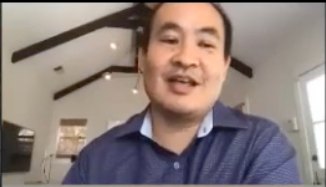
Halfway through, Dennis stopped presenting and asked attendees to drop their website URLs in the chat. Then he audited them on air, one after another, in front of their peers. He also offered to score every URL submitted, for free, afterward.
Watching him do it is the fastest way to learn what actually matters. His sequence:
- Site-wide SSL — not for security, for measurement. Without it your analytics are wrong.
- Facebook pixel (he used the free Pixel Helper extension live), Google Analytics, the Google remarketing tag, and Google Tag Manager. Missing remarketing means you cannot follow up with people who already showed interest.
- Mobile rendering and payload in Chrome DevTools — request count, page weight, load time, iPhone view.
- PageSpeed scores. Farmers National Company scored 91 mobile and 93 desktop, and Dennis stopped the audit to say so: “Normally people are like 20 or 30. You guys, wow — you need to teach everyone what you’re doing.”
- Crawl freshness — a
site:search plus the cache date. “I want the search engine to like my site so much it comes back every day.” - Is there a human on the page? On a tax preparer’s site he found a stock photo of a woman and a child in a forest and asked the room: “Do you believe this? You never see these people when you go to Walmart or Costco.” His fix was a phone video, scripted on the spot for the owner: “I will make sure your taxes are done right. I’m not H&R Block. I’m right here in your neighborhood.”
- Are the testimonials real? On a recruiting firm’s site he found strong written quotes from named clients and said the obvious thing — imagine if even one of those were a thirty-second video from the same person.
He threw in one piece of engagement math worth writing down: a share is worth about 13 times a like, a comment about 6 times, and negative feedback about −100.
Get yours: we still run this audit, and it is still free — request a Quick Audit. Every audit Dennis has published is catalogued in the master list.
The engine underneath the ten steps
The ten items are not ten tactics. They are one machine, and Dennis described how it compounds.
You make many small videos. They land in the library. You put a dollar a day behind them. Most will be bad — “most videos you make you’re going to be terrible; that’s why you need lots of them” — so you let them compete rather than betting on your favorite.
We did something for Infusionsoft. We had a hundred videos. We put a dollar a day against each of them. And of the ones that did well, the winner of the hundred — we put 1.3 million dollars against. We didn’t just say, “we think this is the best footage, put all the money on it.” We let them all compete, like one of those singing shows. Pretend you’re Simon Cowell.
Dennis Yu
The ladder is the same at any budget: $1/day for 7 days to find a winner, then $10 over 10 days, then $30 over 30 days behind what already proved itself. You are never guessing, and you are never spending real money on unproven content.
What has changed since 2020, and what hasn’t
Honest accounting, because a page that pretends nothing moved in six years isn’t useful.
Changed: Google My Business is now Google Business Profile. Twitter is X. Instagram’s cross-posting and boost interfaces have been rearranged more than once — Dennis predicted that on the call, comparing it to the grocery store moving the cookie aisle. TikTok, which he told the room to ignore in 2020 unless they were influencers, now earns a place for some local brands. Ad costs are no longer at the 2012-level lows that COVID briefly created. And the editing work he sent to Fiverr can now be partly done by AI — though the raw footage still has to be a real person.
Unchanged: everything that matters. Your customers still trust other customers more than they trust you. A phone video still outperforms a stock photo. A page in your name still outperforms a logo. Small budgets behind proven content still beat big budgets behind guesses. And AI answer engines — the newest thing in search — reward exactly what this workshop taught: a real named person, corroborated by other people, saying specific things in public, consistently.
The list got more valuable, not less.
Your first week
Niebaum’s closing advice was “don’t try to tackle it all at one time.” Dennis’s was “how do you eat an elephant?” So: one bite.
- Today — fix your Google Business Profile hours. Shoot one 15-second video. Post it to three places.
- Tomorrow — reply to three messages with video instead of text. Facebook comment, LinkedIn message, email. Dennis did all three live on the call and each took under fifteen seconds.
- Day three — create the Facebook public figure page in your own name.
- Day four — teach one technician the fifteen-second review script. Ask one customer.
- Day five — boost your best post. One dollar a day, seven days, five-mile radius, engagement objective.
- Day six — make the shared Drive folder. Move everything you already have into it.
- Day seven — interview one neighboring business you actually like, and leave them a real review.
Then repeat it. That is the entire program. Here is how we run it with clients who would rather not do it alone.
The 53-second video that filled the room
Two weeks before the workshop, Dennis recorded the invitation on his phone. No set, no script, no edit. It is a working demonstration of item one on his own list — which is why it belongs on this page.
Hello Better Business Bureau friends, I’m Dennis Yu, CEO of BlitzMetrics. Join me June 18th and we’re going to talk about how to build better brands in a time of crisis. Local businesses are suffering, but if you are a strong Better Business Bureau member, you know that your customers do the work for you.
Why the BBB, specifically
Dennis closed by tying the tactics back to why that particular room was the right room:
All these steps are leveraging the thing that brought you to be with the Better Business Bureau — because you believe in trust in the community. You believe that your customers and your employees do the work for you. That if you do a good job and you have great reviews, and that reflects on Google and Yelp and BBB and everywhere else, that referrals are what drive things. Not that you say you’re really good, but that your customers are doing the work for you.
Dennis Yu
And on why he was there at all:
I’m not selling you anything. I retired 15 years ago. My agenda is I want to see you implement this, and be so awesome, and see that your businesses are growing because of these techniques — then you go and tell everyone else. I want to create the ultimate virus of doing this.
Dennis Yu
Bring this to your organization
The BBB is one of many institutions that have handed Dennis their members: chambers, trade associations, Small Business Development Centers, and universities including Johns Hopkins. The format on this page — live teaching, live audits of real member websites, and a checklist people can run the next morning — is the format we bring.
If you run an association, a franchise network, or a conference: see what a session looks like, or tell us about your event. For universities and colleges, we also run a dedicated Content Factory University Program.
If you are the local business: start with the free Quick Audit. It is the same audit Dennis ran live on that call.
Frequently asked questions
When was this Better Business Bureau workshop recorded?
It was taught live on Thursday, June 18, 2020, and published to the Better Business Bureau’s YouTube channel on June 21, 2020. The full recording runs 1 hour 28 minutes.
Is the advice still current, given it was recorded during COVID?
Yes. Only two moments are pandemic-specific — telling customers you are open, and a note that ad costs were unusually cheap in mid-2020. Everything else was already twenty years old when Dennis taught it. See what has changed and what hasn’t above.
What is “dollar a day”?
Boosting an organic post for $1 a day for 7 days to a tightly targeted local audience, then putting more money behind only the posts that earn engagement. Full method: Dollar a Day for local services.
Do I need good video equipment?
No. Every video demonstrated in the workshop was shot on a phone, unedited, in one take. Dennis shot several of them live on the call. Editing can be outsourced for a few dollars; the footage cannot.
Can Dennis Yu teach this to our members?
Yes — that is what this recording is. Tell us about your event, or read more about booking Dennis to speak.
Source: “Building Strong Brands with Digital Marketing Expert, Dennis Yu,” published by the Better Business Bureau (@bbbmidwestplains) on June 21, 2020. All quotations on this page are transcribed from that recording. Hosted by Jeff Niebaum and Margo Riekes. More about Dennis Yu.
Originally published .