
Installing AI agents at a local service business takes about three hours on site, roughly $100 of model spend for the session with a few hundred more to finish the day, a computer with real memory, and one person willing to supervise the work as it happens. On Wednesday, August 5, 2026, we did exactly that at Hippo Roofing’s headquarters in Melbourne, Florida. This is the full recording and an honest account of the day, including the install that failed on the client’s own machine and the moment the audit caught one of our own mistakes in front of the people paying us.
Disclosure: Hippo Roofing is our client. Dennis Yu is our chief technology officer, and Jack Allard runs the account and filmed the session.
Watch the full session
Nothing is cut. If you are deciding whether to hire an agency to do this at your business, the useful parts are the failures, the costs, and the conversations about who has to change how they work.
One limit worth naming: the recording carries no speaker labels, so where we could not identify who was talking, we described them rather than guess.
What Hippo asked for, and the pressure behind it
The stated goal was leads. Dennis put it in the brief in one line: “Our big goal is to increase marketing leads. There is another competitor in town, and they’re doing some stuff which is causing them to get business from us.”
Behind that sits a succession problem. Bill Stillwell and Wanda own Hippo Roofing together. They have been married 57 years, Bill is 81, and he had a stroke. Dennis raised it with the model on camera while asking how the family story should figure into the marketing.
“Bill is 81. He had a stroke, so… And he’s… already, uh, moving towards, you know, legacy and equipping the team.”
The job was more leads. The reason the job is urgent is that the work has to keep running in the hands of people who did not build it.
The install on the client’s machine had already failed
Before the camera started, we tried to install Claude on Isabelle’s computer so the agents would run on Hippo’s hardware after we flew home. Her machine ran an old version of macOS with 16 GB of memory. Dennis reported the failure inside the brief he dictated at minute seven.
“We tried to install Claude on Isabelle’s computer, but it was so old… It was just too old. It couldn’t work, and unfortunately, we’re having to do it right here on my computer.”
So the entire session ran on Dennis’s laptop, which has 128 GB of memory and was already using 92 of them twelve minutes in, and 97 later in the day. We publish the numbers because the hardware question comes up in every install we run, and a number is more useful than a reassurance.
When Hippo asked what would actually be enough, the answer was specific.
“So two computers, 48 gigs, that’ll get us started? Yeah. Yeah… Ideally more than two, but as many as finance can afford or justify.”
We finished the work that afternoon. The agents never moved onto Hippo’s hardware on camera, and we have not confirmed it since.
What we had before we walked in
Three hours was enough only because the agent did not start from nothing.
Hippo has a Basecamp project where we log stats and work every week. Dennis told the agent to read that record before forming any opinion, then explained to the room why the record exists.
“Why do we document everything? It’s so that the agents can come in… and look at how Scorpion was billing us. Look at what the different updates are.”
Scorpion is the agency Hippo worked with before us. Dennis told the room the record showed nobody there had logged into the ad account or marked any leads. That is his account of what the history contains, and not something anyone verified on camera, and Scorpion has not been asked to respond.
The lesson for anyone shopping for an agency is narrower than the accusation. A written weekly record is what makes an agent useful on day one. Without it, the first session gets spent explaining your business, which is the reason our onboarding process front-loads the record keeping.
The brief is the job
Dennis held down a function key and talked for about five minutes using Wispr Flow. The transcript of that brief runs 884 words. He was on the paid tier at $12 a month and told the team the free version would serve them fine to start.
Before he said a word, he set three things:
- Approvals, set to automatic so the agent stops asking permission every time it wants to act
- The model, set to the cheaper of the two capable ones on purpose
- The effort level, set to Extra and raised to Max once the brief was in
“We put it on a smart model like Opus 5, not Fable 5, which is twice as expensive. This is when you’re writing code, and you need something really complex. But Opus 5 is 99% as good.”
The brief named the building, the people in it, what they wanted, every system holding data, and what counted as proof.
“It has to be tied towards proving that we made the phone ring that resulted in more jobs. We see it in JobNimbus, we see it in ServiceTitan, and we can prove the incremental ROI of what we’re doing.”
One line decided how the whole engagement feels afterward.
“Prepare a list of specific things that we can do, prioritizing the agentic things that you can do, meaning that you can do that, so that Isabelle and Amanda and Mona and other folks can supervise the work but take full credit.”
The agent ranks what it can execute above what a person has to execute, and the credit goes to the client’s staff. We sell that arrangement. We took that brief apart line by line on the BlitzMetrics site, if you want the mechanics rather than the engagement.
The brief only works if the agent can reach the systems it names, which is the purpose of the access checklist we use. Nothing useful happens before the first rows of that list are green.
What came back by 4:21 that afternoon
By 4:21 PM the agent had worked through its plan and struck through every visible item but one.
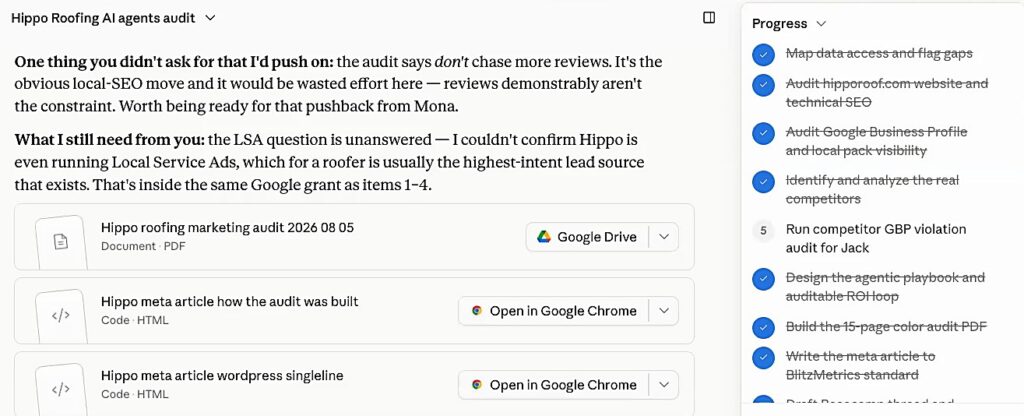
Three finished files sat under the text:
- A sixteen-page color audit PDF on Google Drive
- A meta article documenting how the audit was built
- A second copy of that meta article formatted for WordPress
The agent also opened a Basecamp thread itself and assigned one of the to-dos to Jack. The single open item was a competitor violation audit, which Dennis had already said would become a task for a person, since the agent does not finish that one alone.
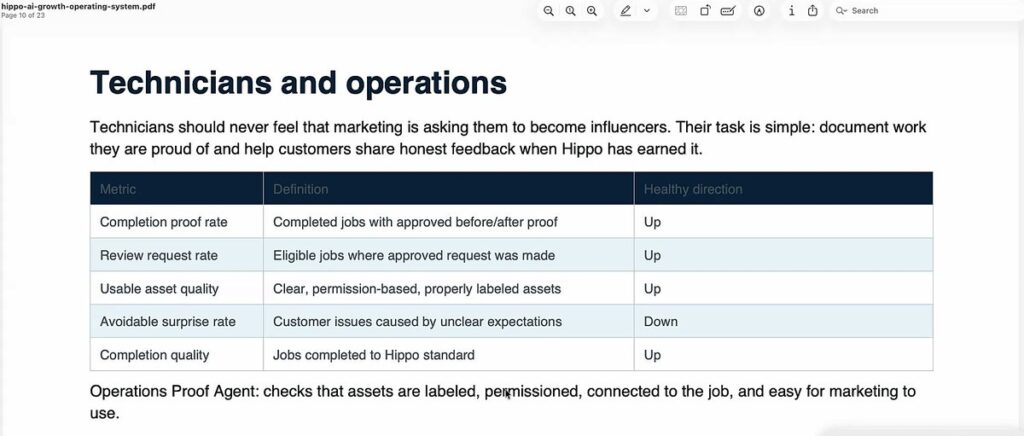
ChatGPT, running on the same laptop, produced its own document from a separate request. Dennis asked ChatGPT for a 20-page PDF with an executive summary at the front, and it came back at 23 pages.
What the audit found
This is the part to read twice, because it is what you are buying.
The roofer sitting at the top of the Melbourne map results has 132 reviews. Hippo has 681. One person in the room asked, “Did I read that right?” Another answered, “I saw it too. I was like, what?”
In Daytona Beach the picture reverses. A company called Jowell Roofing, holding four reviews, outranks Hippo and its 681. Review count decided neither market. The obvious advice most agencies give was the wrong advice here.
Hippo’s own homepage title read “Hippo Roofing: Palm Shores & Melbourne Roof Repair & Replace.” Palm Shores has roughly 900 residents. Melbourne has about 85,000. The audit put it in one line: the single most important line of text on the site was pointed at a town of about 900 people instead of a city of 85,000. The specials page turned out to be empty.
The audit produced three complaints worth filing. One competitor lists a Connecticut phone number for Daytona Beach and another lists a Miami number. Two have no Florida registration and no roofing license.
Somebody in the room put the value of that plainly.
“It would take us so much, as humans, to try to figure out all this… take weeks to do all this, and it did it right now… for, like, a few dollars.”
The agent argued with us, on purpose
Two lines in the brief looked like manners at the time. Both came back with something.
Dennis gave the agent explicit permission to report a gap instead of guessing, and it used that permission on the most expensive gap available. Hippo does run Local Service Ads. The point is that the agent could not confirm it from the access it had been given, which is the gap.
“What I still need from you: the LSA question is unanswered — I couldn’t confirm Hippo is even running Local Service Ads, which for a roofer is usually the highest-intent lead source that exists. That’s inside the same Google grant as items 1–4.”
He also invited it to say what he had missed, and it argued against the move most agencies would have sold.
“One thing you didn’t ask for that I’d push on: the audit says don’t chase more reviews. It’s the obvious local-SEO move and it would be wasted effort here — reviews demonstrably aren’t the constraint. Worth being ready for that pushback from Mona.”
Reviews appear nowhere in the brief. The agent raised them anyway and named the person likely to disagree.
The audit caught us too
Dennis told the agent to report problems even when the problems were ours.
“Don’t be afraid of offending us. If there are things that we’re doing that you know could be better, let us know. We seek the truth, even if it embarrasses me or Jack or other people, because we wanna do what’s right.”
It took him at his word. The agent put its findings about our own performance into a thread the client can read, and led with them.
“The uncomfortable part, which I put in writing in a client-visible thread: the two biggest root causes are ours. Google Ads, LSA, Analytics, Tag Manager and Search Console were requested April 8 and never granted — four months of billed work while every system that measures it stayed disconnected, with no escalation.”
It also found that the Strategy Assessment had zero replies since April 8, meaning there was no goal on record to measure against, and it flagged live WordPress admin passwords sitting in plaintext in a thread the client can read. It noted that it had not used them and told us to rotate them that week.
Then it did the thing we most wanted to see. It checked itself before accusing anyone.
“Two times verification saved us. ‘Metal Roofing Contractor,’ sitting at #1 above Hippo, looked like a textbook keyword-stuffed fake. It’s a real LLC with active license CCC1337805 — filing would’ve been rejected and weakened the three legitimate complaints. And a Google snippet suggested Jack missed a review-count fix; the live page was correct, the index was stale. I nearly named a colleague wrongly in front of the client.”
Read that second one carefully, because it is the opposite of the story it first appears to be. Jack had not missed anything. A stale Google snippet made it look that way, the agent checked the live page, and it caught the error before it could name Jack out loud in front of the people paying us.
It shipped the whole thing to Basecamp itself, notifying seven people, with twelve to-dos carrying owners and dates.
We publish this because an agency that only shows you flattering findings is selling you a different product. Hippo can point any agent at our work and ask whether it clears the audit standard we publish. Wanda does not run pay-per-click campaigns, but Dennis said she can still run that audit, read the report, and hold us to it.
The part about people
The hardest thing in the room had nothing to do with installation.
“We have to turn a worker into a team lead. But a lot of them just won’t. Either they’re resistant to AI, they’re still stuck in the way they’ve always done it, or whatever. They don’t want to. And it requires a higher level of EQ and people skills to coordinate.”
Every person we install this for has to move from doing tasks to supervising work. Dennis was blunt that plenty never make the move at all.
A Hippo staff member said the useful version of this out loud.
“I’ve been trying to reconcile if we do put the agent out there, and then it’s not perfect. I was unable to mentally wrap my head around it, kind of being like a person you have to train.”
That is the correct instinct. The output arrives at roughly the standard of a new employee, 80 or 90 percent right, and it stays there unless somebody corrects it and puts the correction into the file the agent reads next time. Those files are what we publish in our library of installable agents, so an improvement made for one roofer reaches every other business using the same method.
What it costs
We gave Hippo the real numbers on camera.
An hour in, the session blew through Dennis’s account limit. He put the work to that point at about $100, then topped the account up by a few hundred more to keep going. For Hippo’s own account he laid out the ladder plainly: a $20-a-month plan will not survive serious use, so expect to move to $100, then $200.
Running an agent on a schedule in the cloud rather than on somebody’s laptop costs about 8 cents per hour of actual run time, which for a weekly job is a rounding error.
That is the software floor underneath any agency that tells you they are doing this for you, before anything we charge on top.
Where we were careful, and where you should be
Near the end of the session Dennis asked the model on camera whether the AI should get access to QuickBooks. The answer was to give it eyes before hands, meaning read-only at first, no payroll or banking details, and no money moving without a person approving it.
Brittany, sitting in the room, took the follow-up and asked whether to connect QuickBooks directly or upload a CSV of the profit and loss statement. The model said that uploading a limited file is safer to start, and that those numbers should never live inside a permanent skill file, since that is private financial data.
One section of the session covers auditing competitors for Google Business Profile violations and reporting them. Dennis raised the ethics of that himself, unprompted, and answered it. In his words local search is “a dog-eat-dog thing,” a zero-sum market where pushing a rival down moves you up. His defense is that Google publishes the standards and no longer polices them at scale. Hippo had itself been suspended once after somebody flagged it. Anyone copying that part should decide where they stand before running it.
What we still owe Hippo
This is an account of an install. The results are not in yet.
- We have not confirmed the agents moved off Dennis’s laptop onto Hippo’s machines
- We have not asked Justin, the person Dennis named as the readability test, whether he read the audit PDF and understood it
- The competitor violation audit is still an open task with Jack’s name on it, and the Local Service Ads question the agent flagged is still unanswered
We will publish the answers in this same place when we have them.
Is your business ready for this?
The honest test is organizational. Four questions:
- Do you have a written weekly record of your marketing that somebody outside your company could read?
- Can you name the system where a booked job is recorded, and does your agency reference it?
- Is there one person on your team who would check an agent’s work every week?
- Would you want to be told, in front of your team, that your own agency missed something?
Four yeses mean three hours is genuinely enough to start. If the first two are no, the first work is writing down what happens in your business every week, so that any agent picking it up later is useful on day one. The ten-step local business checklist is where we would start you, and it costs nothing.
We do this install for local service businesses. To find out whether yours is ready, start with the Quick Audit we run first, and we will tell you honestly, including when the answer is not yet.
—
Originally published .