
I get 1,000 emails a day. I travel constantly. I run multiple projects with teammates all over the place. People always ask me how I do it, so let me show you.
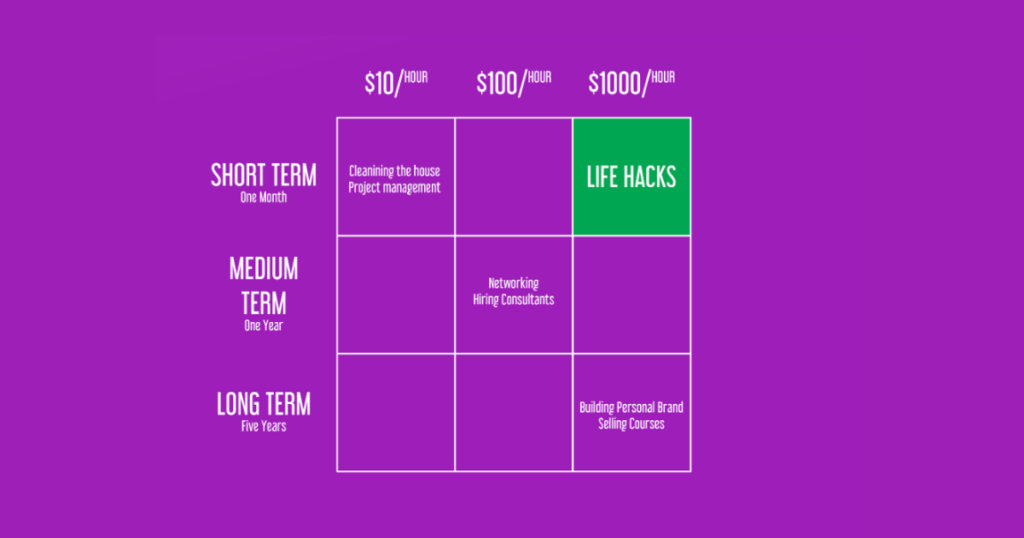
Not all hours are created equal
I think of my tasks in three buckets: $10/hour work, $100/hour work, and $1,000/hour work.

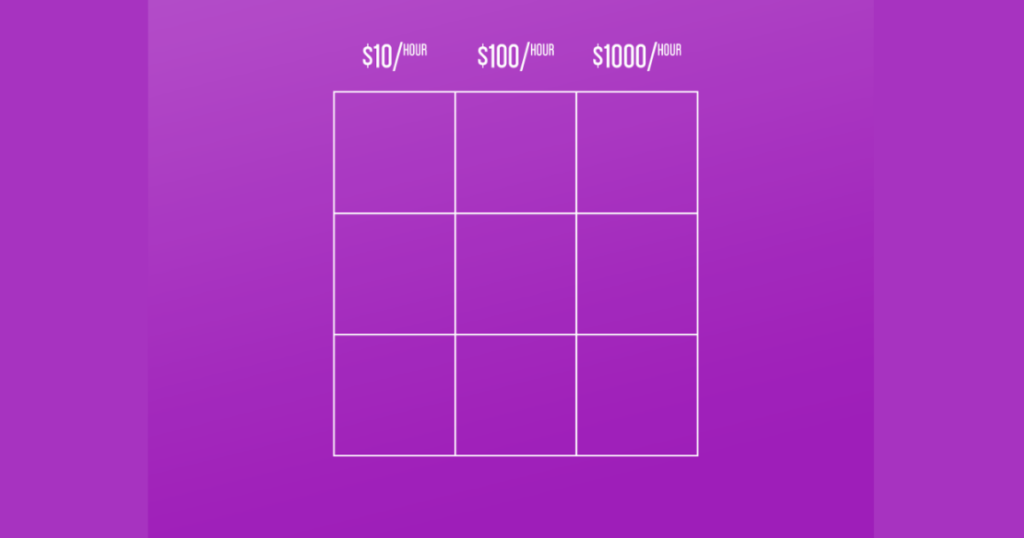
Cleaning the house, doing laundry, chasing people on email. That’s $10/hour work.
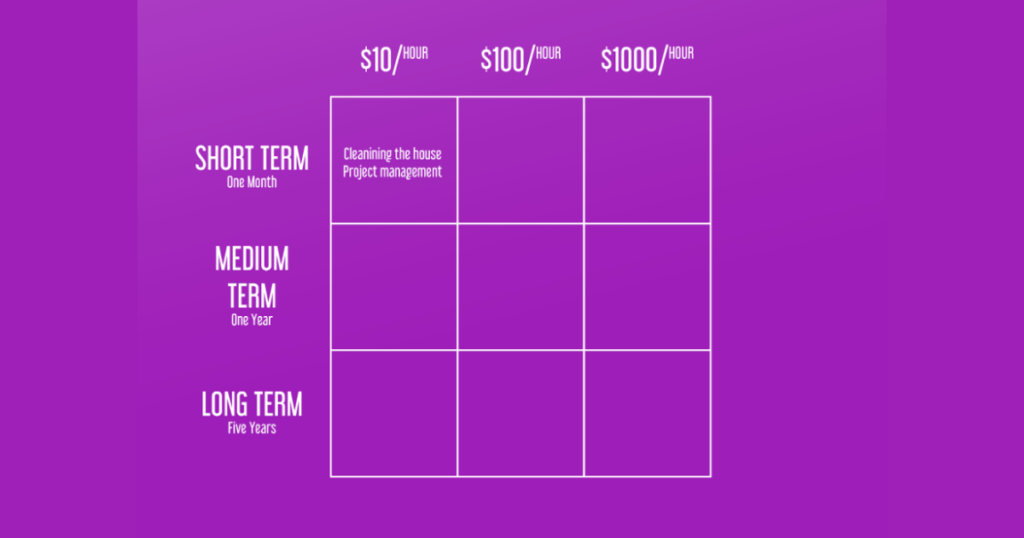
Optimizing a campaign, coaching a teammate, making a presentation. That’s $100/hour.
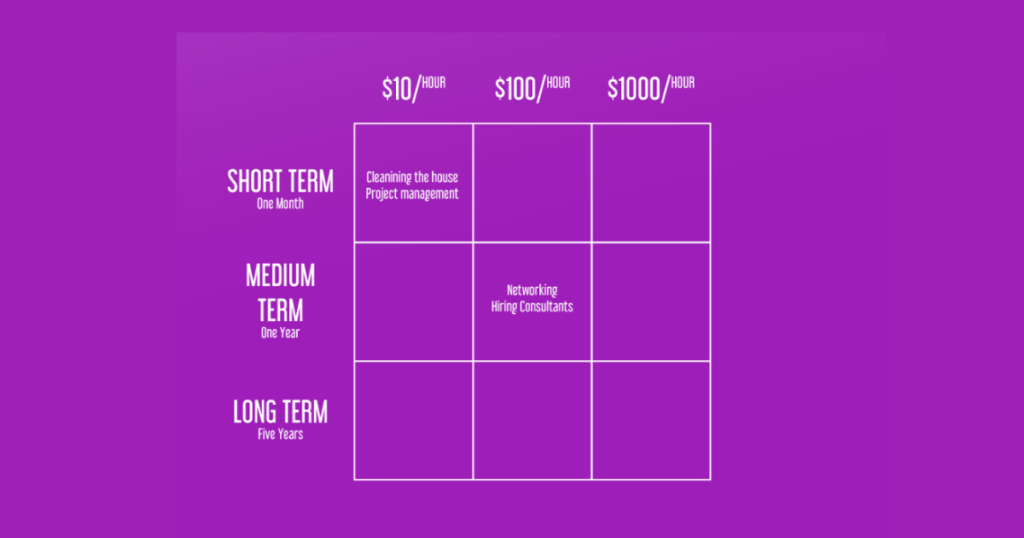
Building software that generates recurring revenue, closing a deal that transforms my business, setting long-term strategy. That’s $1,000/hour.
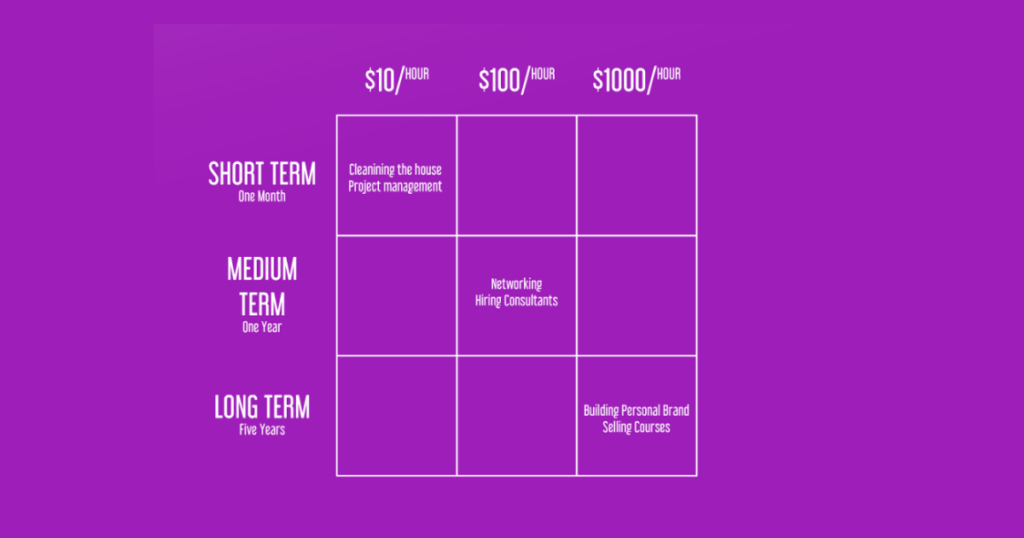
When I’m honest with myself, and I’d challenge you to do the same, most people spend about 80% of their time in the $10/hour bucket. The way I 10X the value of my time is by shifting as many hours as possible from that $10 column into the $100 and $1,000 columns.
The three-by-three grid
I take those three value levels and map them against three time horizons: short-term, medium-term, and long-term. That gives me a simple nine-box grid.
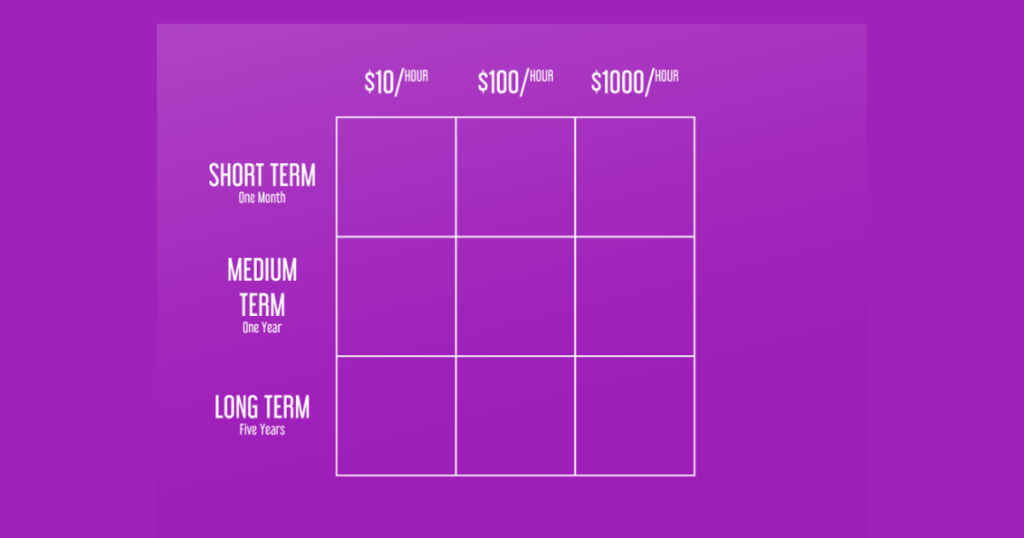
Most people live in two places on that grid. They’re either drowning in the top-left corner, overwhelmed by urgent low-value tasks, or they’re dreaming in the bottom-right corner, fantasizing about what their business could look like someday.
The secret is bridging the gap through the medium term. That’s where I build processes, develop my team, and create systems that compound over time.
The laptop burndown method
Here’s a trick I use. I take my laptop to a coffee shop. I leave my power cord at home. I sit down and work on whatever task I’ve been avoiding the most.
I watch the battery go down. I’ve got two hours, maybe less, to get it done. I can’t fool around, surf the internet, or chat with people. I have to focus. It’s like defusing a bomb before the timer hits zero.
When I think about time with that kind of urgency, not because I’m panicking but because I’m being intentional, I find that most tasks take far less time than I expect. I can write most articles in 10 minutes. Something that might take someone weeks, I can knock out in 10 minutes. It’s not because I’m better. It’s because I feel the urgency of time.
Context switching is killing your productivity
Imagine you want to mow the lawn and eat a bowl of cereal. Instead of doing them one at a time, you take one spoonful of cereal, walk outside, start the lawnmower, mow one line, turn it off, walk back inside, sit down, take another spoonful. Back and forth, one spoon, one line.
It would take all day. You probably wouldn’t even finish.
That’s what context switching does to your brain. Every interruption is like an airplane getting slammed from cruise altitude back down to the runway. It takes 20 minutes to climb back up. But most people never get there because the next interruption hits before they’ve recovered from the last one.
The average person touches their phone 150 times a day. Every notification, every glance at social media, every “quick” message resets the clock.
Put the big rocks first
You guys have probably heard this one. A teacher fills a jar with big rocks and asks the students if it’s full. They say no. He pours in pebbles. Still not full. Then water. Now it’s full.
Most people think the lesson is that you can always fit more in. It’s not. The lesson is you put the big rocks in first. If you start with the pebbles and water, the big rocks will never fit.
My big rocks are the high-value, non-urgent goals that actually move my life forward. Getting a major deal done. Building out a new course. Having that important strategic conversation. These aren’t burning emergencies, which is exactly why they keep getting pushed aside.
Communicate, iterate, delegate
I think of my workflow as a sandwich. Communication is the top bun. Iteration, the actual work, is the meat. Delegation is the bottom bun.
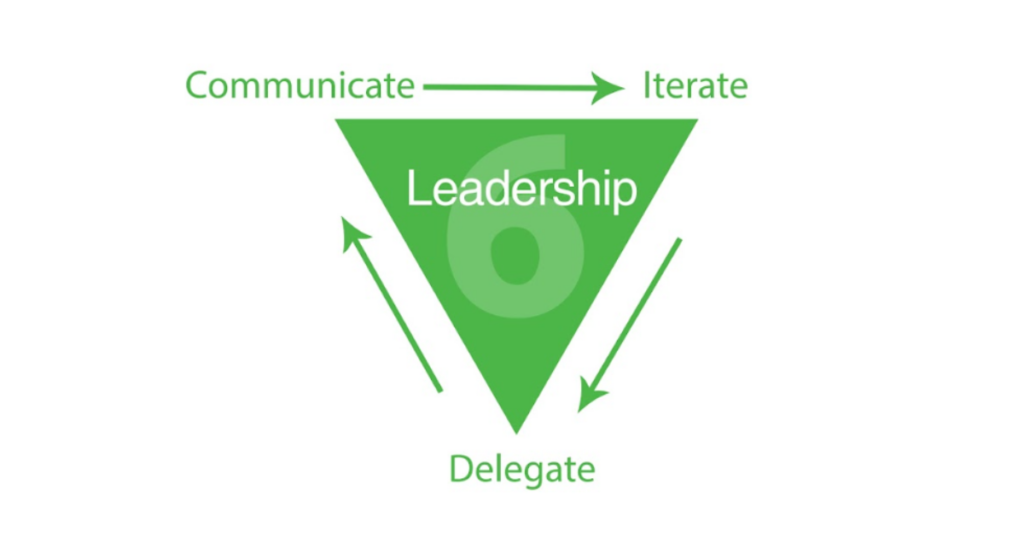
Communication is lightweight and fast. It takes me 10 seconds to tell someone what they need to know. “Hey, this deadline is coming up.” “Hey, this thing is going well.” Quick touches prevent misunderstandings and keep projects moving.
Iteration should also be fast. Most tasks, if I’m focused and not distracted, I can get done in 10 to 15 minutes. Not 100% perfect, but 80% of the value in a fraction of the time.
Delegation is how I free myself from the $10/hour work. I hire AI Builders. I outsource operational tasks. I build checklists and processes so other people can handle what used to consume my day.
I say no constantly
This is huge. I say no all the time. Not rudely, but clearly.
“Let’s hop on the phone for five minutes.” No, because there is no five minutes. It always becomes an hour.
“Here’s a great opportunity.” No, because every yes is a no to something more important.
“We should partner up.” No, because partnerships without money on the table are usually just a polite way of saying “work for free.”
When I say no, I’m not closing doors. I’m protecting the time I need to work on the things that actually matter.
Half my day is open
One of my mentors was Al Casey, the CEO of American Airlines. He used to spend half his day looking out the window at planes. Younger executives thought he was lazy. He wasn’t. He was thinking, strategizing, planning. That’s what they were paying him to do.

I need that same open space. Not because I’m idle, but because the most valuable work often doesn’t look like work. It’s the relationship I build over a three-hour lunch, like the one I had yesterday with one of the most successful businessmen in Utah. If my calendar had been packed, I would’ve missed that completely.
If every minute of your calendar is spoken for, you’ve lost the ability to be proactive. You’re just reacting.
Now multiply all of this with AI agents
Everything above is about shifting from low-value to high-value work. But there’s a next level.
All those $10/hour tasks to delegate? AI agents now handle them for a fraction of the cost, faster than any AI Builder team could.
Here’s how to get started with your first AI agent today.
The three-by-three grid still applies. The big rocks still go first. But now one person with AI agents can clear out the entire low-value column without hiring anyone.
If you’ve 10X’d the value of your time using the frameworks above, AI agents can multiply that by another 100X.
If you run a home service business, here’s exactly how to implement AI agents for SEO.
Time vs. money
You can always make more money. You cannot make more time.
My buddy Bill Harnish, the billionaire who funded Best Buy and Costco, once waited in a parking lot for 40 minutes while I bought a pair of running shoes at the Nike outlet. I saved $15. Later I thought about what his time was actually worth during those 40 minutes. He wasn’t just sitting there, of course. He was trading stocks and making calls. But it made me think differently about how I value my own time.
Take your tasks, sort them into the three-by-three grid, delegate what you can, eliminate what you should, and protect your calendar for the work that matters most.
That’s how you 10X the value of your time.
Originally published .