
“My name is too common to ever get a Knowledge Panel.” We hear it weekly, and it’s wrong. A crowded name isn’t a dealbreaker — it’s a disambiguation problem, and disambiguation has a playbook.
Take Nathaniel Stevens, the founder who built Yodle into a roughly $342 million exit to Web.com and now runs Punchey and the Stevens Auto Group. Search his name and you’ll meet the crowd: a statistics professor at the University of Waterloo, a Massachusetts attorney, an IMDb writer, and 100+ profiles on LinkedIn. Can he still earn a panel that’s unmistakably him? Yes — and so can you. Here’s how.
The core idea: Google can hold many different people under one name. Your job isn’t to “own” the name — it’s to give Google enough distinct, consistent signals to recognize you as a separate entity and attach the panel to the right person.
First, understand how Google sees names vs. people
A name is a string of text. An entity is a thing in the world — and inside Google’s Knowledge Graph every entity gets a unique machine ID (you’ll see them as /g/... or /m/... identifiers, called KGMIDs). Three different Nathaniel Stevenses can each have their own entity ID. The name collides; the entities don’t have to.
Google decides which entity to show — and whether to show a panel at all — based on how distinct and well-corroborated each entity is. The professor’s entity is reinforced by a university page, academic publications, and a faculty profile. If your entity is thin or scattered, you lose the slot to whoever’s signals are cleaner. So the goal is simple to state: make your entity the most clearly-defined, most consistently-corroborated “Nathaniel Stevens” in your domain.
The two ways a common name actually fails
Failure 1 — No distinct entity
Google can’t tell you apart from your namesakes, so it shows no panel, or worse, a panel that blends two people together.
Failure 2 — Split / duplicate entities
Your own signals are scattered across several entity IDs — LinkedIn points at one, Crunchbase at another — so none is strong enough to win. (Nathaniel had exactly this: duplicate person KGMIDs splitting his signal.)
Both failures have the same fix: consolidate and distinguish. Pull all your signals onto one entity, and make that entity obviously different from the namesakes.
The crowded-name playbook
1. Choose your canonical name — the one people actually search
Pick the exact name string you’ll use everywhere. Almost always that’s the name people already type, not a longer legal version. Don’t rebrand to a middle initial hoping it earns a panel — that’s a common and costly mistake we break down in its own article:
→ Should You Add a Middle Initial to Get a Google Knowledge Panel?
2. Lock your disambiguating attributes — and keep them identical everywhere
Entities are told apart by their attributes. Decide on yours and repeat them, word for word, across every property: occupation, current employer, what you founded, city, alma mater, and birth year. The professor is “Associate Professor of Statistics, University of Waterloo.” Yours might be “Founder of Yodle and Punchey; CEO of Stevens Auto Group, Milford, CT.” Consistency is itself the signal — mismatched facts tell Google your profiles might be different people.
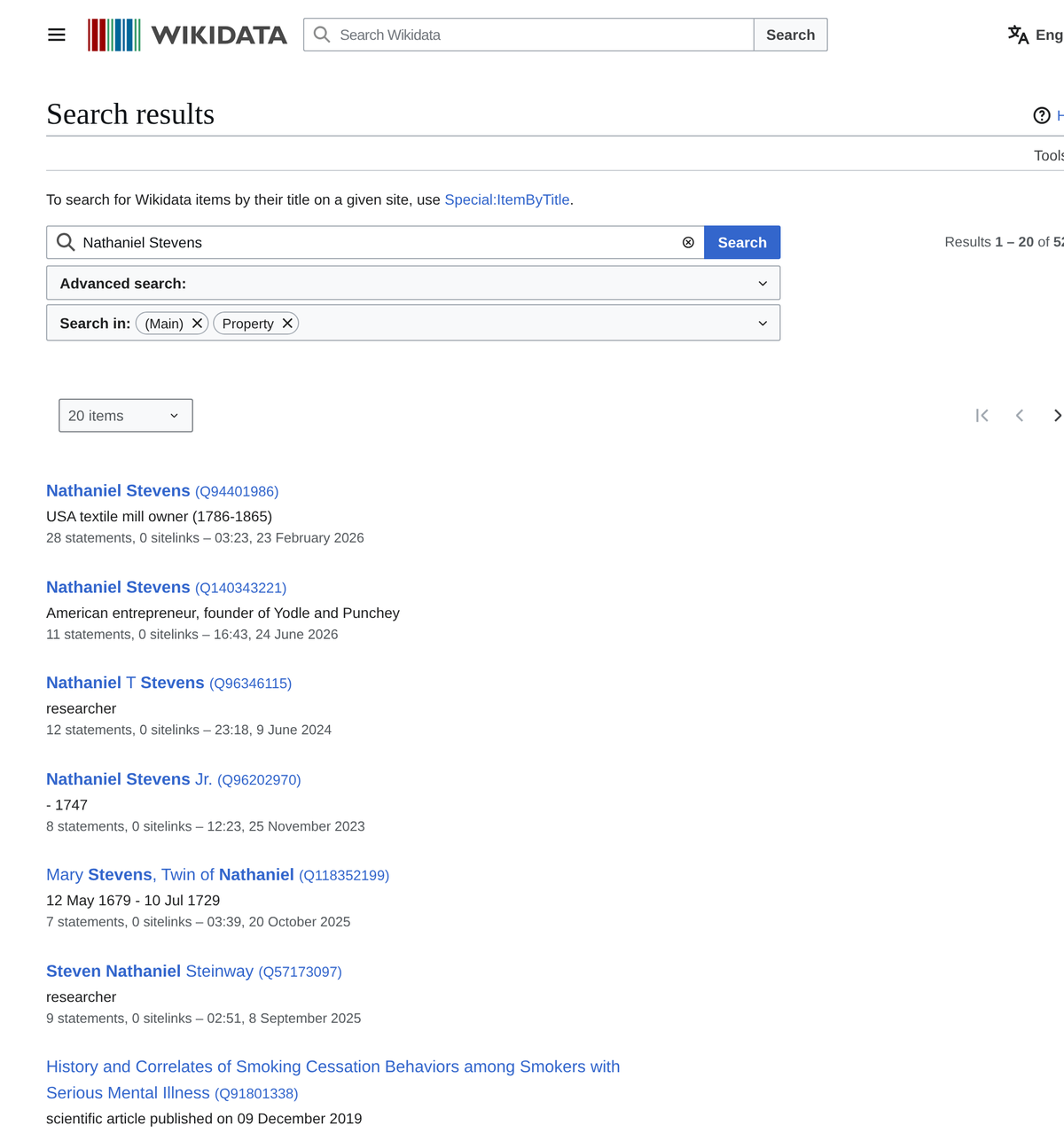
3. Create a Wikidata item — and use “different from”
Wikidata is a direct Knowledge Graph feeder with a lower bar than Wikipedia. Create an item with your distinguishing statements (occupation, employer, founder-of, date of birth, official website). Then use the property different from (P1889) to explicitly point at your namesakes’ items. That property exists for precisely this situation — it tells Google “this Nathaniel Stevens is not that one.”
4. Consolidate every profile onto one entity with sameAs
On your entity home, add Person schema whose sameAs lists all your profiles — LinkedIn, Crunchbase, IMDb, X, your companies. This is the instruction that fuses scattered signals into a single entity and resolves the duplicate-KGMID problem.
5. Put a disambiguation block on your entity home
Add a short, human-readable section to your site: “Which Nathaniel Stevens? The founder of Yodle and Punchey — not the University of Waterloo professor or the Massachusetts attorney.” It helps real visitors and gives crawlers clean disambiguation text. (We build this into every crowded-name entity home, Nathaniel’s included.)
6. Reconcile duplicate entity IDs
If Google already holds more than one entity for you, claim what you can, then drive consistent signals at the strongest one and use Google’s “suggest an edit” / feedback paths. Over time the corroborated entity wins and the duplicates fade.
7. Earn third-party coverage that names you with your attributes
A podcast, press hit, or directory that says “Nathaniel Stevens, founder of Yodle” is worth more than ten that say “Nathaniel Stevens.” Coverage that pairs your name with your distinguishing facts is what trains Google which entity is which.
The two highest-leverage moves
If you only do two things: (1) create a Wikidata item with “different from” pointing at your namesakes, and (2) add a disambiguation block + complete sameAs to your entity home. Together they consolidate your signal and separate you from the crowd faster than anything else.
Worked example: Nathaniel Stevens
Nate is the ideal case because the name is so contested and his raw material is so strong. He has a ~$342M exit (Yodle → Web.com, in SEC filings), a second founded company (Punchey), a Crunchbase profile, a Wikipedia article that once existed, and — as he noted himself — an IMDb presence to build out. The work isn’t to invent notability; it’s to disambiguate and consolidate what’s already real:
- Canonical name kept as “Nathaniel Stevens,” with “Nathaniel Vincent Stevens” added only as a schema/Wikidata attribute.
- A “Which Nathaniel Stevens?” block on his entity home, naming the professor and the attorney so there’s no confusion.
- Person schema with a complete
sameAsset, pulling his duplicate entity IDs back into one. - A Wikidata item with “different from” the academic and legal namesakes — the move that most directly tells Google he’s a separate entity.
None of that is a rebrand. It’s disambiguation — the correct tool for a crowded name.
Related reading
Wondering whether a middle initial is the shortcut? It isn’t — and here’s the full reason, with the Clifford E. Wright IMDb breakdown.
Read: Should You Add a Middle Initial to Get a Knowledge Panel? →Want help untangling a crowded name?
Disambiguating a common name is exactly the kind of methodical entity work we do — entity home, Wikidata, schema, and consistent signals, scored against a 100-point rubric. See what it takes to earn a Knowledge Panel, or get yours built done-for-you.
FAQ
Can I get a Knowledge Panel if many people share my name?
Yes. Google can hold a separate entity for each person with the same name. You earn a panel by making your entity distinct and well-corroborated: a canonical name, consistent disambiguating attributes, a Wikidata item, Person schema with complete sameAs, and a disambiguation section on your entity home.
What is the fastest way to separate myself from people with the same name?
Create a Wikidata item and use the “different from” (P1889) property to point at your namesakes, and add a disambiguation block plus a complete sameAs list to your entity home. Those two moves consolidate your signal and distinguish you from the crowd faster than anything else.
Should I add a middle initial to stand out from my namesakes?
Use your full legal name only as a structured attribute (schema legalName/additionalName, Wikidata alias) — not as a public rebrand. A middle initial doesn’t create a panel; the underlying entity does. Keep your brand on the name people actually search.
What are KGMIDs and why do duplicates hurt me?
A KGMID is the unique ID Google assigns each Knowledge Graph entity (shown as /g/ or /m/ identifiers). If Google has created more than one entity for you, your signals split across them and none is strong enough to trigger a clean panel. Consolidating profiles with sameAs and driving consistent signals at one entity fixes it.
Go deeper: → How to Use Wikidata to Get a Google Knowledge Panel
→ Who is eligible for a Wikidata page?
Fighting a crowded name? That’s one of the trickiest cases, and exactly what we untangle in our Knowledge Panel package — we disambiguate your entity and build your panel for you.
Originally published .