
Not everyone can — or should — have a Wikidata item, and the single biggest reason do-it-yourself Wikidata pages get deleted is the one nobody checks first: eligibility. Wikidata isn’t a profile you fill out. It’s a database of notable entities, and items that don’t clear the bar get removed — sometimes taking the creator’s account reputation with them.
So before you follow a step-by-step Wikidata item guide, run the eligibility test. Below is the plain-English version, a checklist, and where real personal brands actually fall on the spectrum.
The test in one line: You’re eligible if you can be described using serious, publicly available references that are independent of you — press, a notable company or role, a published book, an industry or sports database. If the only sources are your own website and social accounts, you’re not eligible yet.
Why eligibility is the first question, not the last
Wikipedia and Wikidata are different bars. Wikipedia requires “significant coverage” judged by editors — a high bar. Wikidata is more lenient: an item is allowed if it’s a clearly identifiable entity describable with serious, public references, fills a structural need, or has a Wikimedia sitelink. For a person, the first one is what matters.
But “more lenient” still isn’t “anyone.” Create an unsourced or promotional item and a patroller nominates it for deletion, often within days. For a young account, a burst of borderline items can get the whole account flagged.
Checking eligibility first protects your time and your account.
The practical eligibility checklist
Score yourself honestly. The more of these you can point to with an independent link, the safer your item:
- Independent press — articles, interviews, or features about you in outlets you don’t own.
- A notable company or role — founder or executive of a company that itself has coverage, an acquisition, or filings.
- A published book with an ISBN from a real publisher — a strong, citable anchor.
- Verifiable achievements — an acquisition, an award, an official record, a sports or industry database listing.
- Existing structured presence — IMDb, Crunchbase, ORCID, a sports database, or an org registry.
Two or more with independent sources, and you’re very likely eligible. If everything points back to your own site, build coverage first.
The eligibility spectrum, with real personal brands
Here’s where real brands land — the contrast is the lesson:
Clearly eligible — already on Wikidata
Independent coverage made these automatic. They don’t need an item created — their job is to link the existing one to their entity home.
- Daniel Larimer (Q47253335) — blockchain pioneer behind EOS, BitShares, and Steem; extensive independent press.
- Dennis Yu (Q12246156) — digital-marketing entrepreneur and author, widely quoted and cited.
- Julian David (Q124757262) — international sport climber listed in sports databases.
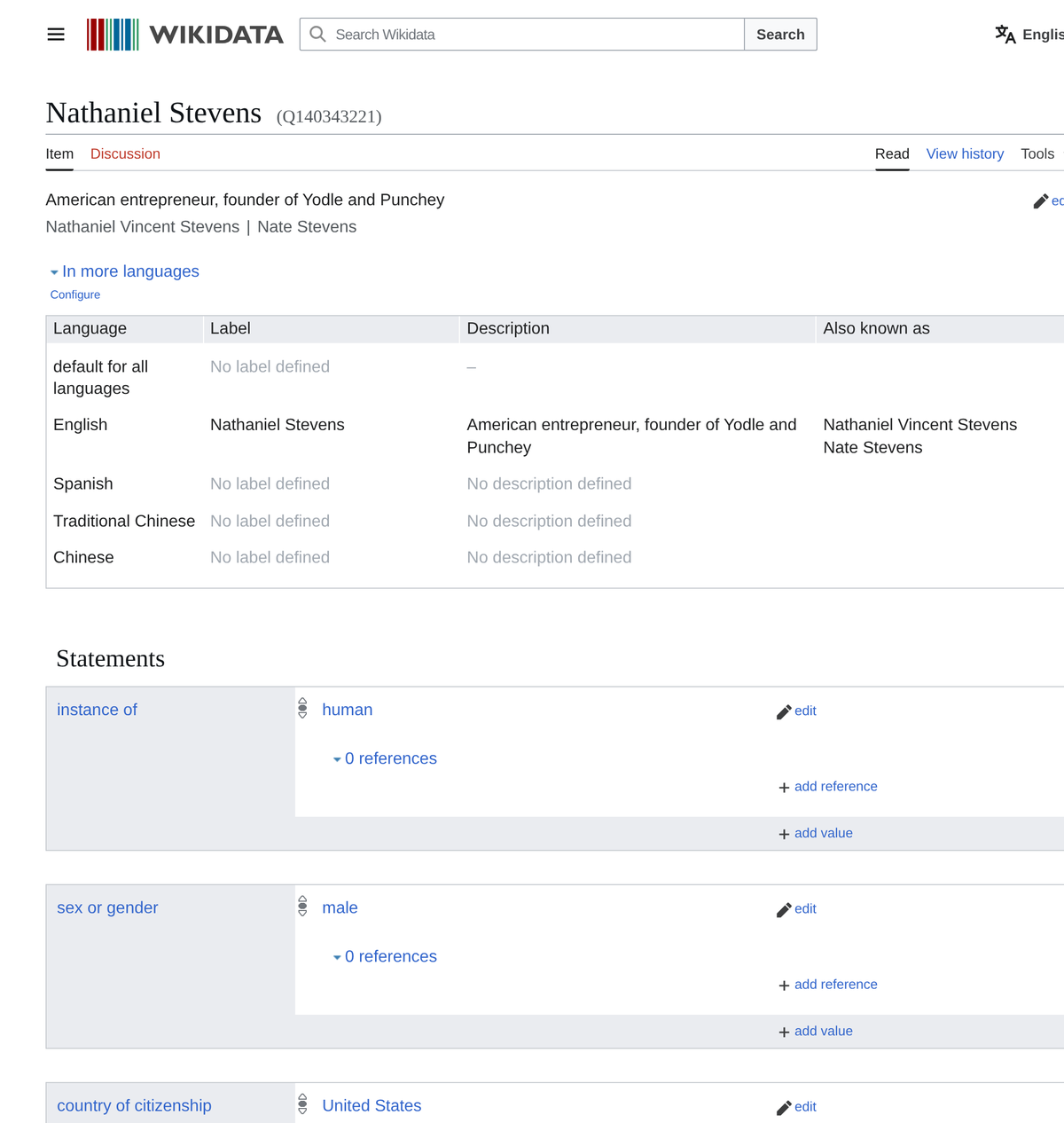
- Nathaniel Stevens (Q140343221) — founder of Yodle, whose ~$342M acquisition appears in SEC filings and business press.
Eligible — items we built (and why each cleared the bar)
Borderline on first glance, but each has a verifiable company plus independent references — enough to describe them seriously:
- Matthew Januszek (Q140351195) — co-founder of Escape Fitness, an international company with trade-press coverage.
- Dan Antonelli (Q140351196) — founder of KickCharge Creative; multiple published books plus features in MSNBC and Entrepreneur.
- AJ Wilcox (Q140351197) — founder of B2Linked, published author and LinkedIn Learning instructor.
The pattern: a company you can verify, plus a book or independent press, equals describable with serious sources, equals eligible.
Not eligible yet — build notability first
The largest group: real, talented people whose coverage is still mostly their own channels.
- An emerging athlete before national press or an official record.
- A local-service owner known to customers and reviews but not to journalists.
- A coach or creator with a following but no independent write-ups.
A Wikidata item created now would likely be deleted. The fix isn’t to force it — it’s to earn the coverage that makes it stick.
One rule we never break: don’t link to a negative entity
Connecting a brand to its Wikidata or Wikipedia entry is powerful — it tells Google “this is the authoritative entity.” But power cuts both ways. Before you link a person to any entity, confirm two things: that it’s actually them, and that it’s framed accurately. Same-name entries are common, and some carry an unflattering description or a damaging record. A negative authoritative reference is worse than no link at all. If the only matching item misrepresents the person or describes someone else, we leave it unlinked and build a clean entity instead. Reputation first — always.
Not eligible yet? Do this instead
Eligibility is earned, and you don’t need Wikidata to start building search presence. The path with no notability gate:
- Stand up your entity home — your own site with complete Person schema. This works for everyone, immediately.
- Earn independent coverage — podcasts, guest articles, local press, an industry award. Each one becomes a future Wikidata reference.
- Then create the Wikidata item, once the references exist, and link it back — the full steps are in how to use Wikidata for a Knowledge Panel.
That’s the same sequence we score on the 100-point Personal Brand Score: entity home first, authority second, Wikidata once you’ve earned it.
Don’t
- Create an item sourced only to your own website — it reads as promotional and gets deleted.
- Inflate titles or invent achievements — Wikidata is heavily patrolled and cross-checked.
- Mass-create items for a roster of people at once — the fastest way to get an account blocked.
The full Wikidata & Knowledge Panel series
→ How to use Wikidata for a Knowledge Panel (the build steps, once you’re eligible)
→ Earn a Knowledge Panel with a common name
→ Whether to add a middle initial for a Knowledge Panel
Get an honest eligibility read
We’ll tell you the truth about where you stand — eligible now, borderline, or build-first — and then do the work: entity home, references, and the Wikidata item when it’s earned. Get your Knowledge Panel built for you, or see what it takes to earn a Knowledge Panel. What does your reference list look like today?
How we keep this current: a weekly fleet audit
Eligibility isn’t static — a book ships, a company gets acquired, an athlete earns national press — so we don’t treat Wikidata as a one-time setup.
Every week we re-audit the whole roster of brands against a living registry: re-verify that each existing item is live, accurate, and pointed at its entity home; add any missing official-website link or reference; and create one or two newly eligible people with their references checked first.
The discipline that protects the work is the drip — a few well-sourced items at a time, never a bulk upload — because mass-created items get deleted and can take an account’s standing down with them. If you clear the bar, this is how you stay correctly represented as your coverage grows.
FAQ
Can I create a Wikidata page about myself?
Yes, if you’re eligible. Unlike Wikipedia, Wikidata lets you create your own item — but only if you’re a clearly identifiable entity describable with serious, publicly available, independent references (press, a notable company or role, a published book, a database listing). If the only sources are your own website and social profiles, an item will likely be deleted.
What makes someone notable enough for Wikidata?
Independent, reliable references that describe you. The strongest signals are press coverage you don’t control, a company with its own coverage or an acquisition, a published book with an ISBN, an award, or a structured database listing such as IMDb, Crunchbase, or a sports database. Two or more with independent links makes eligibility very likely.
Is Wikidata eligibility the same as Wikipedia notability?
No. Wikipedia requires significant coverage judged by editors — a high bar. Wikidata is more lenient: an item is allowed if it’s a clearly identifiable entity describable with serious public references, fills a structural need, or has a Wikimedia sitelink. Many people who don’t qualify for a Wikipedia article still qualify for a Wikidata item.
Why was my Wikidata item deleted?
Almost always notability or sourcing: it was supported only by your own website or social accounts, read as promotional, or duplicated an existing entity. Add independent references, remove promotional language, ensure you aren’t duplicating an entity, or build more independent coverage before trying again.
Originally published .