
A founder texted us a screenshot of his friend’s Google Knowledge Panel and asked the question we hear constantly: “Maybe I should use my middle name?” It’s a reasonable guess. It’s also the wrong lever — and chasing it can quietly cost you the search equity you’ve already built.
The friend was film producer Clifford E. Wright. The founder was Nathaniel Stevens — the man who built Yodle into a roughly $342 million exit to Web.com, founded the payments platform Punchey, and runs the third-generation Stevens Auto Group in Milford, Connecticut. Cliff’s name shows a clean panel: photo, “Film producer,” a tidy bio. Nate’s name shows… a crowd. So the instinct is natural: if Cliff’s panel has that middle initial, maybe the initial is the secret.
It isn’t. Here’s what’s actually going on, and what to do instead.
The one-sentence answer: A middle initial does not create a Knowledge Panel. Authoritative entity data creates the panel — the initial is just how a source like IMDb tells two same-named people apart after the entity already exists. Use your middle name as a disambiguation attribute, never as a rebrand.
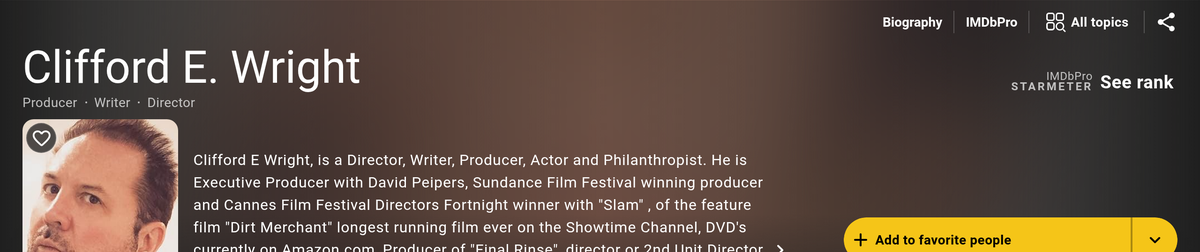
Why Clifford E. Wright has a panel — and it’s not the “E.”
Cliff’s panel says “Film producer.” That label is pulled straight from his IMDb profile — credits like Dirt Merchant, Sleep With Me, and Promoter Wars, representation by ICM, and his company Wright Media Capital Productions. IMDb is one of the most trusted feeders into Google’s Knowledge Graph. When Google sees a structured, credit-backed entity in IMDb, a panel is close to automatic.
So where does the “E.” come from? IMDb assigns it. There is more than one Clifford Wright in the world (there’s a well-known food writer, for one), so IMDb — and Google after it — carries the middle initial to keep the entities separate. Dennis put it perfectly in the text thread:
“Cliff has the knowledge panel because of his links from IMDb, which automatically does the middle initial with others that have the same name.”
Read that carefully, because it’s the whole lesson. The middle initial is downstream of the entity, not the cause of it. IMDb created a strong entity; the initial rode along to disambiguate it. If you bolt a middle initial onto a name with no authoritative entity behind it, nothing happens. You don’t get a panel — you just get a longer name.
Correlation, not causation. “People with panels often show a middle initial” is true. “Adding a middle initial gives you a panel” is false. The initial and the panel are both effects of the same cause: a well-formed entity in a source Google trusts.
What actually creates a Knowledge Panel
A panel appears when Google is confident it knows who you are as a distinct thing in the world — a node in its Knowledge Graph with a unique machine ID — and can corroborate the facts about you from independent, authoritative sources. The levers that get you there are the same ones we score in the 100-point Personal Brand Score:
- An entity home — a single owned site (yourname.com) that is unmistakably about you, with Person schema.
- Authoritative third-party sources — IMDb, Wikipedia/Wikidata, Crunchbase, SEC filings, major press — that name you and state your facts.
- Consistent
sameAssignals — every profile (LinkedIn, Crunchbase, IMDb, socials) pointing to the same identity, so Google fuses them into one entity instead of scattering them. - Structured data — Person schema with your occupation, employer, founder-of, alma mater, and links.
- Content and coverage that repeat the same facts in the same way.
Notice what’s not on that list: punctuation. The middle initial is a labeling detail. The Knowledge Graph is built on entities and relationships.
Nathaniel Stevens is closer to a panel than the comparison suggests
Here’s the irony. Compared on raw entity material, Nate has a stronger case than the example that worried him:
- A company with a roughly $342M public exit (Yodle → Web.com, in SEC filings) — covered by outlets including Wharton’s Knowledge program.
- A second company he founded and chairs (Punchey), with a Crunchbase profile.
- A Wikipedia article that used to exist — meaning his notability was formally recognized once.
- And — as he pointed out in that very thread — “I have IMDb.” The same kind of authoritative feeder that gives Cliff his panel.
So the move isn’t to imitate the initial. It’s to build out the entity: claim and connect his IMDb, seed a Wikidata item, lock his Person schema, and make every profile point at one identity. That’s what Cliff has that Nate doesn’t yet — not an “E.”
When the middle name is smart — as an attribute, not a rebrand
There’s a real kernel of truth in the instinct, and it’s worth honoring. “Nathaniel Stevens” is a genuinely crowded name — a University of Waterloo statistics professor, a Massachusetts attorney, an IMDb writer, and 100+ profiles on LinkedIn all share it. When your name is contested, the middle name does have a job: it helps Google tell you apart.
But the right way to use it is as a structured attribute, not a public rebrand:
✓ DO — use it as an attribute
- Add
legalName: "Nathaniel Vincent Stevens"andadditionalName: "Vincent"to your Person schema. - List the full legal name as an alias on Wikidata and in your bios.
- Keep the brand, domain, and headlines as the name people actually search.
✗ DON’T — rebrand to the initial
- Don’t rename the site to “Nathaniel V. Stevens.”
- Don’t re-do your headlines, handles, and GBP around the initial.
- Don’t optimize for a query nobody types.
Why a full rebrand to the initial backfires
Three concrete reasons it costs more than it earns:
- Nobody searches the initial version. Search volume lives on the bare name (“Nathaniel Stevens”), the company names (“Yodle,” “Stevens Ford”), and the brand. Optimize for “Nathaniel V. Stevens” and you win a query almost no one types.
- You abandon equity you’ve already built. If your entity home, schema,
sameAslinks, social handles, and Google Business Profile are all wired to one name, switching the canonical string forces a costly re-do and resets signals you’ve been compounding. - The panel would show on the wrong query. Even if you earned a panel for “Nathaniel V. Stevens,” it wouldn’t surface for the bare-name search where the eyeballs are. Pyrrhic win.
The decision rule
→ Don’t adopt a middle initial hoping it triggers a panel. It won’t.
→ Do add your full legal name as a schema/Wikidata attribute so Google can disambiguate you.
→ Build the real levers: an entity home, authoritative sources (IMDb, Wikidata, Crunchbase), and consistent sameAs links. The initial follows the entity — never the other way around.
Your name isn’t unique? That’s a solvable problem — not a dealbreaker.
The flip side of this question is what to do when several real, notable people share your exact name. There’s a known playbook for that.
Read: How to Get a Knowledge Panel When Many People Share Your Name →Want this built out for you?
Earning a Knowledge Panel is methodical work: entity home, schema, authoritative sources, and consistent identity signals — scored against a 100-point rubric so you know exactly what’s missing. That’s what we do. See how the panel-building process works, or get your Knowledge Panel done-for-you.
FAQ
Does adding a middle initial help you get a Google Knowledge Panel?
No. A middle initial does not generate a panel. Panels come from authoritative entity data — IMDb, Wikipedia/Wikidata, Crunchbase, major press — combined with an entity home and consistent structured data. A middle initial is only a disambiguation label that a source like IMDb attaches after the entity already exists.
Why does Clifford E. Wright have a panel with a middle initial?
Because IMDb has a strong, credit-backed entity for him as a film producer, and IMDb feeds Google’s Knowledge Graph. IMDb carries the middle initial to separate him from other people named Clifford Wright. The panel comes from the IMDb entity; the initial is just the label that distinguishes it.
Should I ever use my middle name for personal branding?
Yes — as an attribute, not a rebrand. Add your full legal name (e.g., legalName and additionalName) to your Person schema, list it as an alias on Wikidata, and include it in bios. Keep your public brand, domain, and headlines on the name people actually search.
What actually triggers a Knowledge Panel?
An entity home (your own site with Person schema), authoritative third-party sources that corroborate your facts, consistent sameAs links so Google fuses your profiles into one entity, and content that repeats the same facts the same way. Score these against the 100-point Personal Brand Score to find your gaps.
Go deeper: → How to Use Wikidata to Get a Google Knowledge Panel
→ Who is eligible for a Wikidata page?
Want the whole thing handled for you? See the done-for-you Knowledge Panel package, where we run every step from audit to live panel.
Originally published .